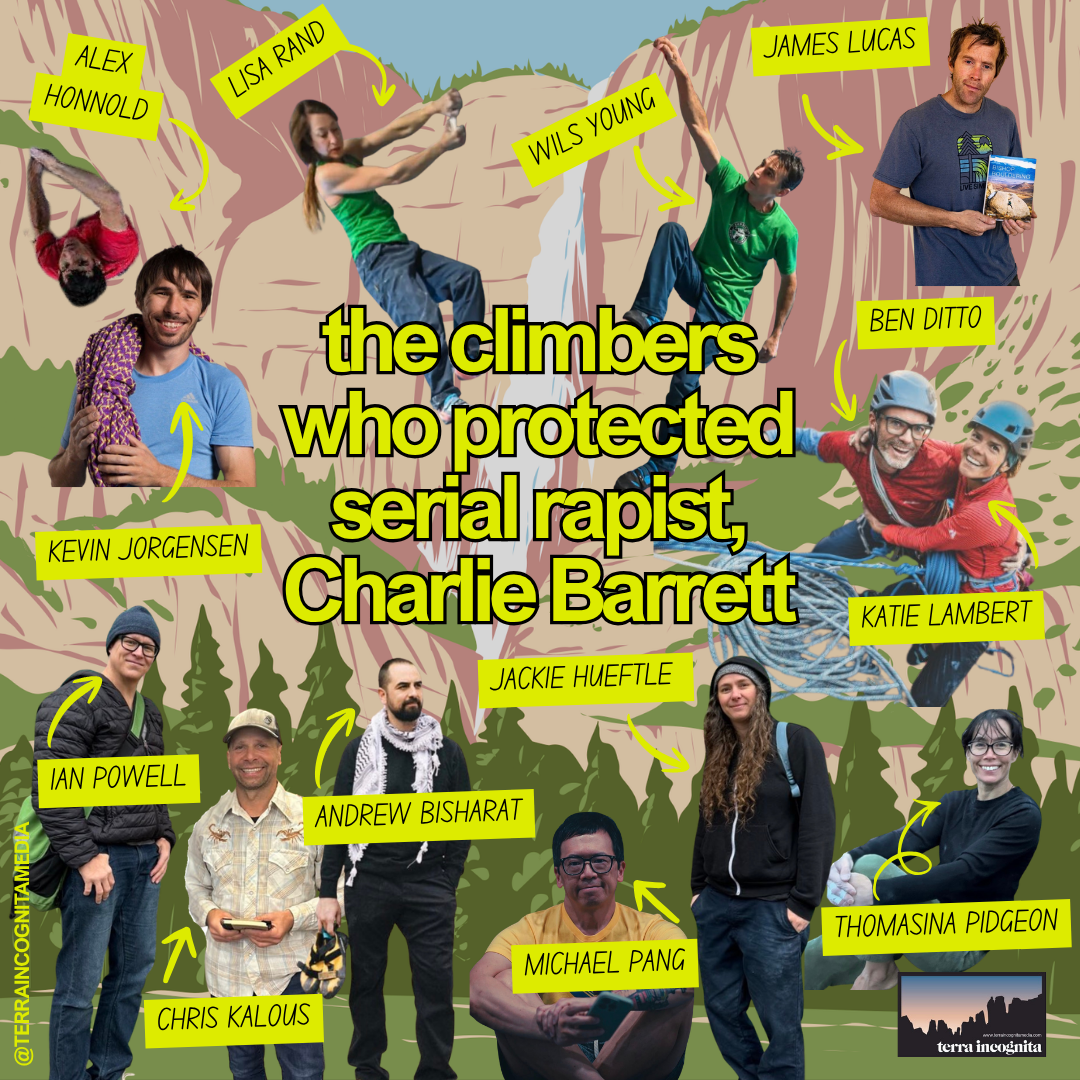
The Real Monsters Are “Good People”: The Outdoors Would Be Safer Without Jackie Hueftle, Ian Powell, Lisa Rands, Wils Young, Alex Honnold, James Lucas, Andrew Bisharat, and Chris Kalous
TRIGGER WARNING: discussion and mentions of rape culture, rape, sexual assault, gender-based violence, and intimate partner violence
It’s not a figure of speech to say that the silence of the climbing “community” is deadly. I’m disgusted by the complicity of Alex Honnold, James Lucas, Andrew Bisharat, Chris Kalous, Chris Summit, Kevin Jorgensen, Ethan Pringle, Ian Powell, Michael Pang, Bill Ramsey, and more “good guys.”
My disgust is equally, if not more so, reserved for the "pick me" women whose only priority is being seen as a "cool girl,” the ones who pride themselves on being "not like other girls," "just one of the boys," which really just means they co-sign men's abhorrent behavior. If they had to choose between believing survivors or licking the bottom of a Katana that just did a lap through the men’s bathroom, they’d choose the latter. They give aggro tech billionaires, trying to prove something to their absent fathers by ascending Mt. Everest (Sagarmāthā in Nepali and Chomolungma in Tibetan), a run for their money: panting without oxygen, scrambling over dead bodies, and chasing the false summit of Mount Patriarchy. I’m talking about women like Katie Lambert and Thomasina Pidgeon who wrote character letters for Barrett after he was convicted, as well as Jackie Hueftle and Lisa Rands.
According to an anonymous source, Jackie Hueftle—who serves on the board of Bolt and Revolt, an organization that aims to create gender equity in the setting space of climbing gyms—not only protected Charlie Barrett while his trial was ongoing, but also defends and supports him to this day. According to this source, Hueftle harassed and intimidated survivors to discourage them from speaking up. The source also said that Ian Powell, Hueftle’s partner, complained about the possibility of “being canceled” if he, Jackie Hueftle, Lisa Rands, and Wils Young were forthright about their belief that the trial against Barrett was “rigged.”
To alert the community about their true feelings about Barrett, I’ve been speaking about their complicity on Terra Incognita Media’s Instagram stories, reels, and posts. I also wrote about this in a recent article, “Himpathy for the Devil: The Climbers Who Supported Serial Rapist, Charlie Barrett.” Powell, Hueftle, Rands, and Young may have hoped to stay out of the limelight of their serial rapist friend’s high-profile case, but they made their rape apologist beds by supporting him, and we’re going to talk about it.
On June 9, 2026, I received a cease-and-desist letter from Powell and Hueftle demanding that I take down my social media posts and amend the article to remove details about their association with Barrett. The letter implied they would sue me for defamation if I didn’t edit out all mentions of Jackie Hueftle and Ian Powell from the article and my Instagram posts. When you’re accused of defamation, you have to prove that what you said was true and that you didn’t make the claims out of malice. What I reported is unequivocally true. I have sources who would testify in court.
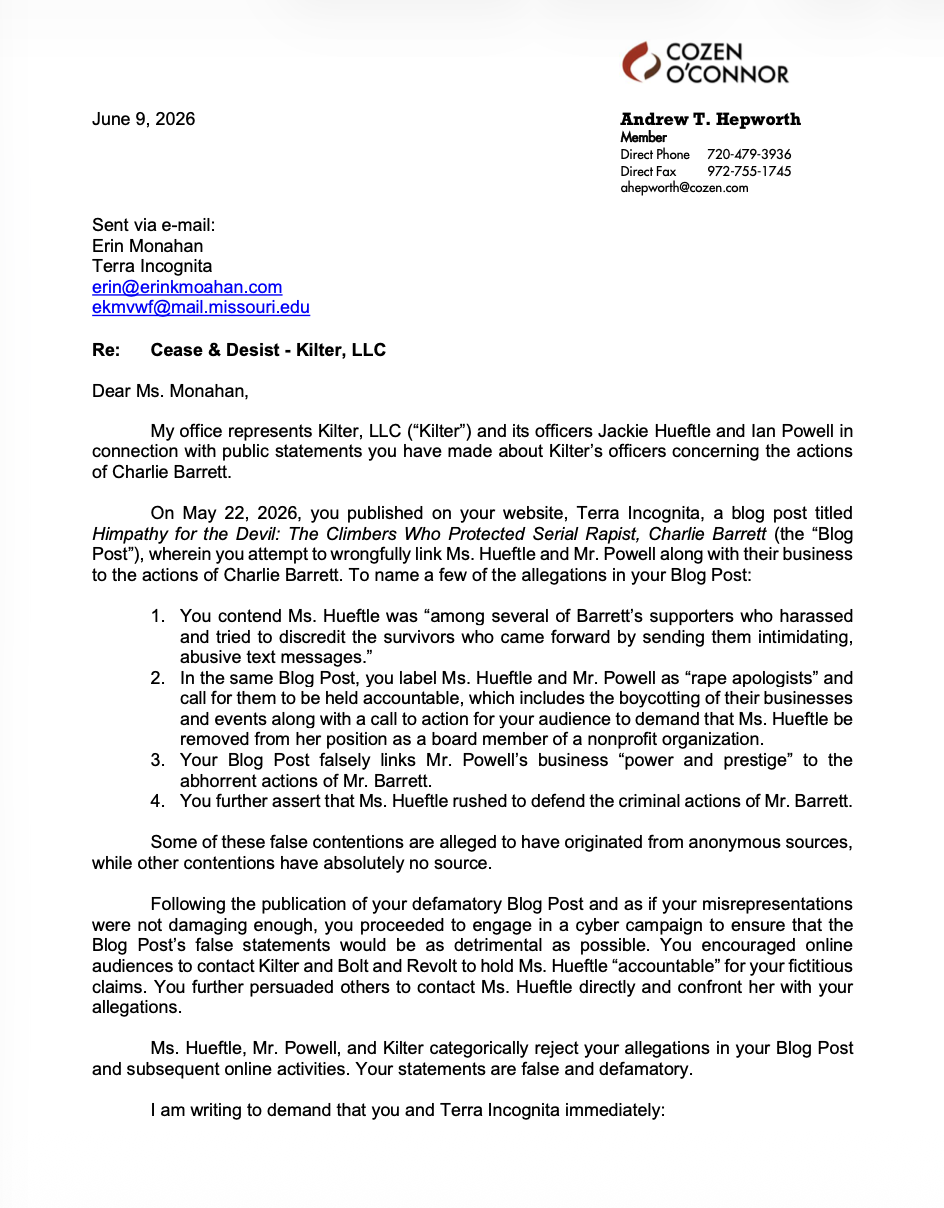
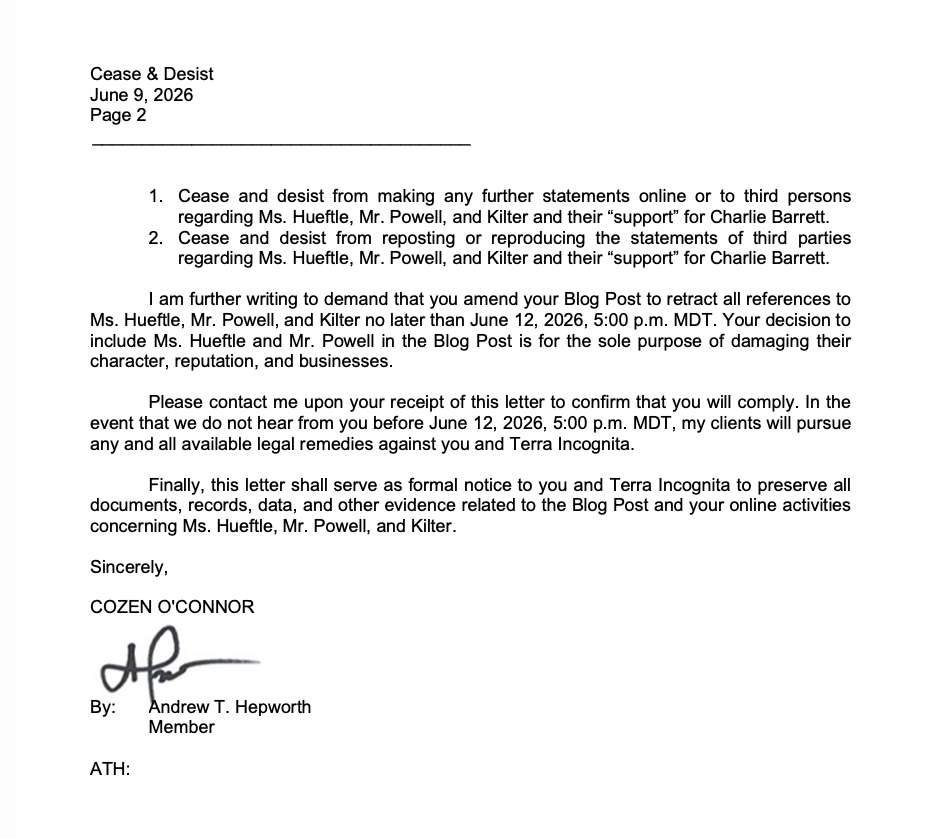
On top of that, my intent in exposing Kilter’s connection with Barrett has always been accountability, not malice. I was completely unaware of these people before I began researching my article, but Powell and Hueftle hold power and influence in the climbing world. And because Hueftle presents herself as someone who cares about gender justice, it’s important that her loyalty to Barrett be widely known. Demanding accountability and boycotting their brands isn’t malicious. It’s a natural consequence of their own actions. The larger climbing community has a right to know who they’re supporting when they interact with them and/or their brands.
Lisa Rands, the owner of Synergy Climbing in Chattanooga, TN, is another himpathizer who used her white-womaness to silence and gaslight survivors. According to the National Park’s Investigative Activity Report (screenshots provided below), in 2007 Rands encouraged her husband, Wils Young, to visit Barrett in jail. Barrett was serving time for reckless, violent behavior stemming from an incident in September 2004.
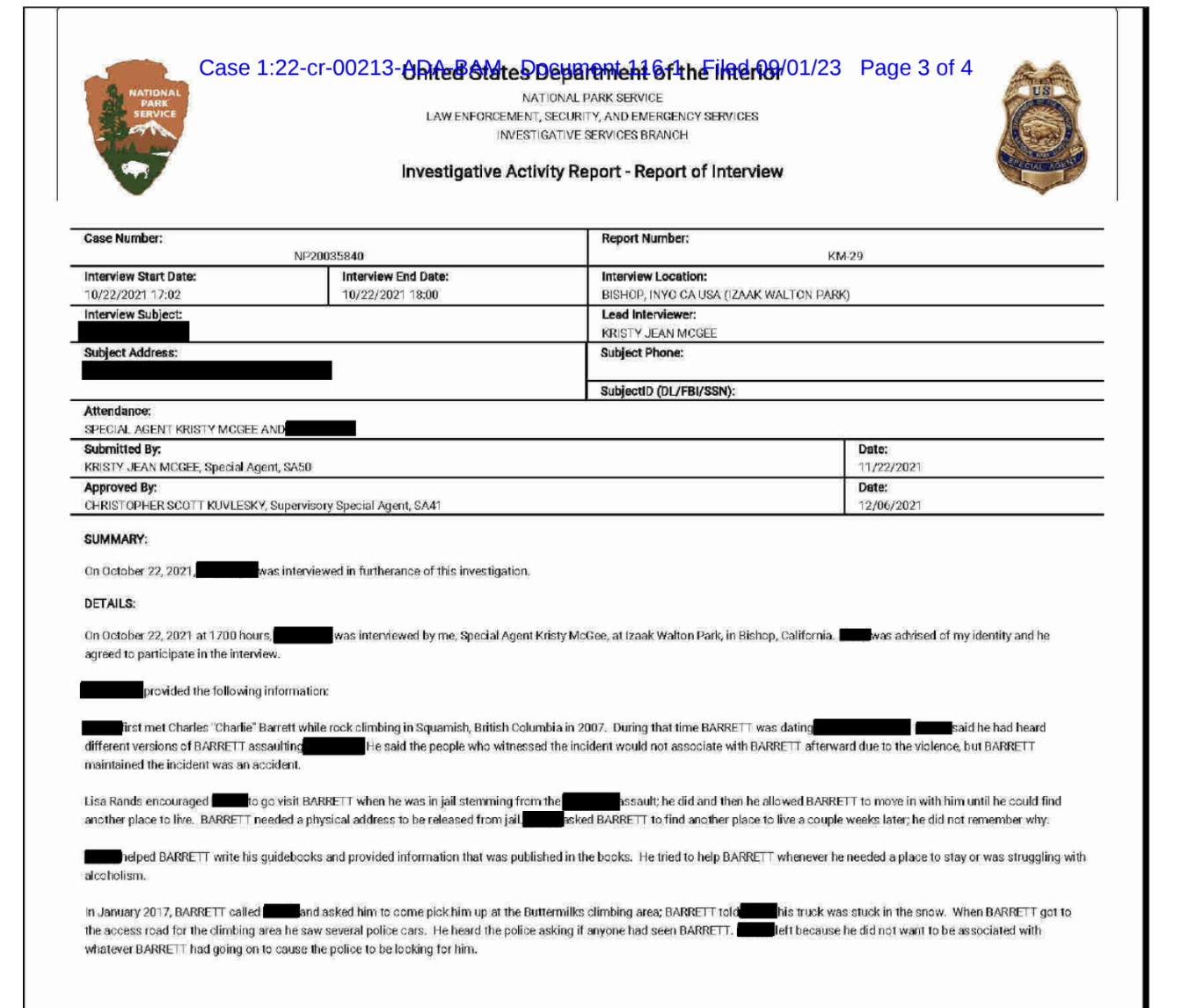
National Park Service Investigative Activity Report, Interview with Wils Young
While living in Yosemite, Barrett “...was arrested by Yosemite law-enforcement rangers and charged with a misdemeanor DUI in Mariposa County…Barrett retaliated against one of the rangers a few days after the incident by slashing the tires on his car. He also made verbal threats against the rangers immediately following the arrest, on the way to a holding station. These actions led to a federal indictment in January 2005 charging Barrett with five felony counts, including witness retaliation and intimidating and interfering with federal officers,” reports McGivney.
While Barrett was navigating the legal system for all of this, he began dating Bonnie Hedlund, one of his survivors. The first incident of abuse Hedlund experienced at Barrett’s hands occurred in January 2006, a year before he went to jail for the Yosemite charges. “[Barrett] backed [Hedlund] into a corner. Then, so suddenly that she had no time to defend herself, he hit the side of her head with his fist, knocking her out,” McGivney writes. According to the National Park Investigative Activity Report (image below), Wils Young said he “had heard different versions of Barrett assaulting [redacted].” It’s reasonable to assume the redacted name Young referred to was Hedlund. As horrific as these details are, what unfolded next was even more harrowing. If you have the capacity, I recommend reading the full story on Outside. Hedlund, like many survivors, didn’t report to the police at the time.
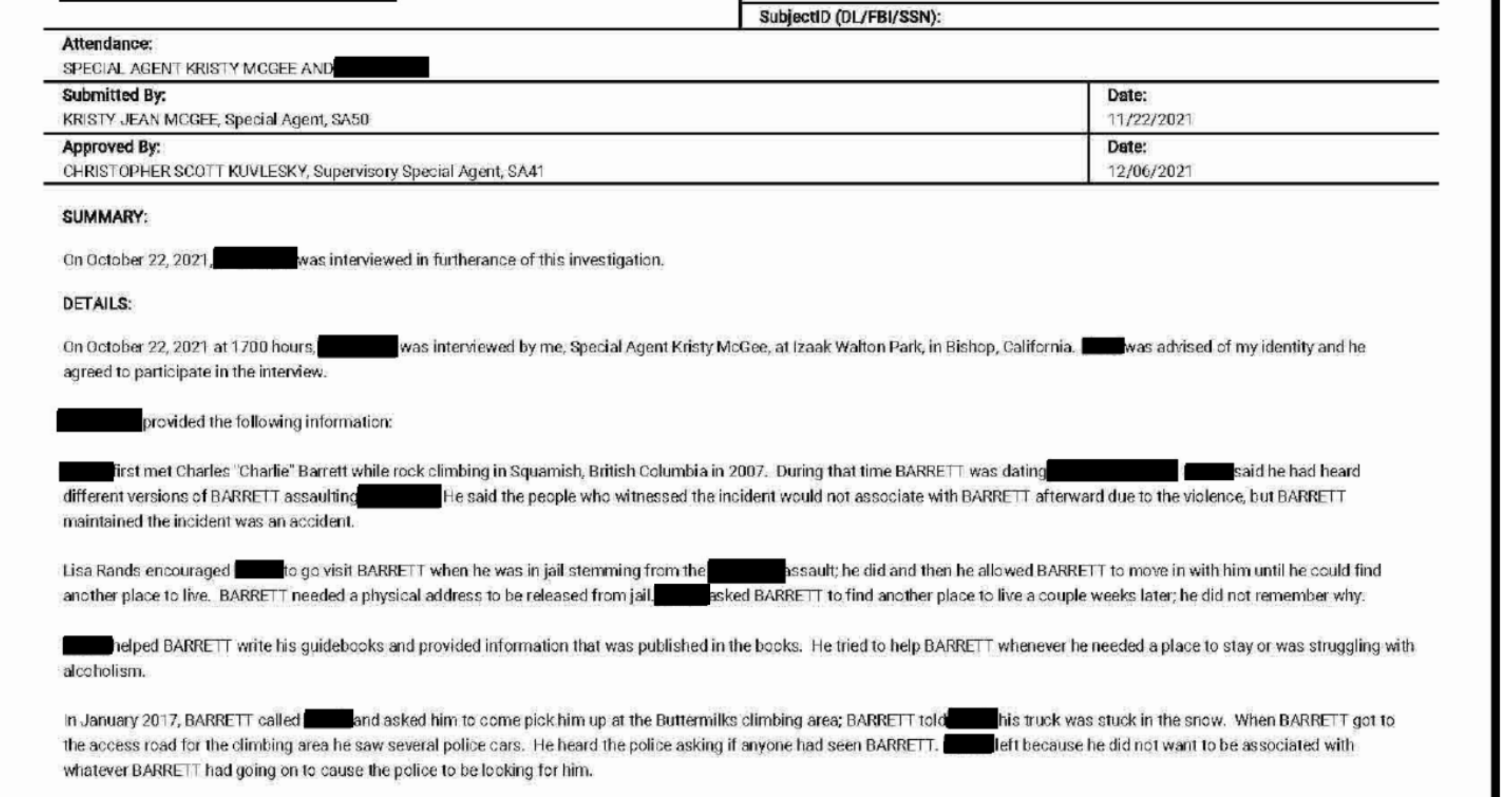
National Park Service Investigative Activity Report, Interview with Wils Young Continued
Why Don’t You Just Go to the Police?
As a survivor of intimate partner violence myself, I deeply understand why Hedlund, along with many of Barrett’s other survivors, didn’t report. Gender-based violence jolts you into survival mode: you’re facing something terrifying and unpredictable, and you’re forced to make the choices that feel safest in the moment, even if they don’t look “logical” to outsiders. And the systems and institutions we live in are designed to protect abusers. Survivors have few real options inside white supremacist patriarchy.
We’re often overcome with confusing feelings of shame and a debilitating fear of retaliation (that the violence will escalate if you involve law enforcement). Many of us also intuitively understand that going to the police rarely results in meaningful protection from the perpetrator. If anything, involving law enforcement often becomes a re-traumatizing experience in which officers may gaslight, victim-blame, or dismiss a survivor’s experience.
For me, my survival response kicked in as a mix of fight and fawn. In the middle of an argument one afternoon, I tried to leave the house that I was living in with my abusive ex. My hand was on the doorknob, but he blocked my way. Through clenched teeth and a ripe fury, I said, “What are you going to do, hit me?” Within seconds, my knees buckled, and I briefly blacked out. In the corner behind the front door, on the cold tile floor, I instinctively curled into the fetal position. My stomach was still braced from being repeatedly kicked. I touched my nose, and blood appeared on my fingers. My ex’s best friend, Lance, lived upstairs, and he was there with his door closed while this was happening. I watched him run down the stairs and step over me as I cried for help. He left, saying, “I don’t want to get involved.” Pathetic coward, I thought.
“Did he hit you?” the officer asked hours later, in the Missouri Psychiatric Center waiting room.
“No,” I replied, trying to sound confident—trying to protect him.
“Then how did you get a black eye?” the officer said.
I touched my face in disbelief. “I have a black eye?”
The officer nodded. For the next two weeks, I covered the discoloration with concealer each morning before greeting the toddlers for circle time in the classroom.
The trauma bond was set two years earlier, when I was 19 and a junior in college. He was 28. We met as co-workers at Noodles and Company, just a half-mile from the University of Missouri–Columbia campus where I was earning my English degree. He initially lied about his age, but I found out when I opened his wallet and saw the ID he’d left on his bed. We’d been dating for a few months by then. Thanks in part to my religious, sex-negative upbringing, I felt trapped. Even though I wasn’t religious and desperately wanted a life not ruled by the oppressive, misogynistic values I’d been fed growing up, I was still subconsciously brainwashed into believing that if I was having sex with someone, it meant I needed to be in love with them, and even plan to marry them.
I was not in love with this person, but I convinced myself I was. With great discomfort and a gross, queasy feeling in my stomach, I forced out, “I love you too.” He had just confessed his love to me over the phone. We were spending New Year’s apart as the Gregorian calendar ushered in 2011. At that point, it felt like I had no choice, otherwise I was just…an immoral slut?
Although I was in a state of complete helplessness after he struck me, I’d been indoctrinated into a lifetime of hyper-individualistic mores like “buck up,” “suck it up,” and “be a strong, independent woman.” His mom was a therapist, and she sat with me along with his step-dad and father. Nobody called it what it was: intimate partner violence. I wouldn’t learn that phrase until almost a year later, while doing research at the Moab library.
No one made sure I had access to therapy or any other kind of support. In the days and weeks that followed, I couldn’t bring myself to tell anyone. I knew I’d be met with gaslighting: “But you’re so strong and smart. How could this have happened?” I knew my decision to be with someone capable of that kind of violence would be questioned. I knew that, essentially, I’d be blamed.
I poured all my energy into insisting that he simply needed mental health support. Everyone around me, especially his mom, enthusiastically agreed. This wasn’t who he truly was, right? He was just tormented, troubled, needed a hug, and to be excused from his violent urges. Instead of advocating for my own mental health after such trauma and violence, we fixated on his well-being. That focus gave my traumatized mind and body a way to project and externalize what had just happened. Slipping into “doing” mode also gave me a sense of control in a situation that otherwise was completely out of my control. Something deep down in me knew I didn’t have the resources or support to truly come to terms with what happened.
Although I moved out after the initial incident, I moved back in a couple months later after he convinced me that he would treat me better. After I returned, I worked overtime: full-time as a Montessori preschool teacher, part-time as an after-school tutor for elementary students, and babysitting on the weekends. Subconsciously, I knew that in order to stay safe I needed to keep out of the house as much as possible and save every dollar I could. My intuition told me to go into overdrive. I worked as many hours as possible in order to save as much as possible, so I could get out.
Nearly six months after the violent event, and while living in a constant state of hypervigilance, I applied to AmeriCorps for a job as an outdoor educator with the park service in so-called Moab, Utah. The job came with a travel stipend, so I wouldn’t have to pay to get there, and it included housing once I arrived. I don’t believe in the Catholic Jesus I was raised to revere, but I begged, prayed, and pleaded with the universe to grant me this position. When I got the call from the hiring manager, I quietly snuck upstairs to Lance’s empty bedroom (he moved out), so I could take the call without my ex hearing. They told me I was hired, and I began sobbing as relief coursed through my system. Escaping that relationship felt impossible unless I could put 1,000 miles between us.
Why Didn’t You Just Leave?
Many people wonder why survivors don’t leave right away or tell friends and family. Abuse makes you feel trapped, and in this society we’re conditioned to believe the abuse is somehow our fault, that we did something to cause the violence. I’m a cis, white woman from an upper-middle-class background. My friends lived within a 15-mile radius, and my family was only a 90-minute drive away. But the shame, self-blame, embarrassment, and trauma were all-consuming.
We’re raised in a white supremacist, patriarchal society that continually tells the most marginalized that their outcomes are theirs alone. We’re taught it’s not a systemic issue; instead, it’s a personal failing if you find yourself in a difficult situation like chronic poverty, houselessness, etc. This toxic “pull yourself up by your bootstraps” ethos conditions all of us to blame ourselves for whatever hardships we may be facing. On the other hand, it also convinces us that if we’re “winning” at the game of capitalism, it’s solely due to our own hard work and grit instead of recognizing things like luck, support, or unfair advantages. This is the biggest lie that racialized capitalism sells us, and it impacts how survivors of gender-based violence are treated and understood.
After driving through Kansas and Colorado I arrived in Moab, began my new job, and soon mustered the courage to break up with my ex over the phone. I found myself in the honeymoon phase of dating someone new, D, and was surrounded by a lively group of friends who introduced me to my love of climbing splitters in the desert. One day, D and I picked up a hitchhiking couple and let them stay at our place. After a night of drinking, talking, and playing music, we all went to bed. A few hours later, just as the sun was about to come up, we were woken up by a police officer banging on the door.
He told us that the man we’d picked up had beaten his partner in the middle of the night. I frantically searched the house for clues, as if I could have prevented it. It happened right outside the bedroom door where we slept. How could we not have woken up? I found blood smeared on the bathroom door, near the light switch, and along the counter. I snapped back into survival mode and drove to the local women’s shelter, where the person I’d been laughing with the night before had been taken.
Later, while catching up with my mom on the phone, I recounted the horror. In a way, it felt therapeutic, because I’d never been able to tell her what had happened to me.
“That’s awful…so terrible,” she said. The sadness and dread in her voice were palpable. “I hope she’s okay, and I’m glad she has you. I know this kind of thing would never happen to you because you’re too smart and strong.”
My heart dropped into my stomach, and silent tears streamed down my cheeks. If only she knew. I couldn’t bring myself to tell her.
I replied, “Yeah.”
Gender-Based Violence is an Economic Justice Issue
The nightmare of gender-based violence is even worse for Black women, Indigenous women, two-spirit folks, non-binary people, people of color, immigrants, and disabled queer folks. My positionality in this world—as a cis, white, college-educated woman from an upper-middle-class background, with no criminal record—is what allowed me to escape. I had the privilege of working two jobs and owning a car that got me to and from work. That same car also allowed me to trek across the country to safety.
Financial security is the number-one resource survivors need to access safety. Having my own bank account, access to funds, and a travel stipend is what kept me from experiencing repeat violence. This happened to me 15 years ago, in 2011. Even with all the overtime and living frugally, I had saved $800. Adjusted for inflation, that would be $1,184.39 today. I was deeply grateful to have that money available to me. But the point is this: even with the privilege and power I hold, rent and living expenses meant I could still only save that much. Imagine how much more difficult, if not nearly impossible, it is for someone with less privilege, especially someone experiencing not only physical abuse, but also financial and sexual abuse.
According to survivors.org, “Research shows that an estimated 94% of survivors of intimate partner violence experience financial and economic abuse, yet 78% of Americans do not consider financial and economic abuse to be a form of abuse at all. No form of abuse is ‘worse’ or ‘better’ than another, but financial and economic abuse is unique in that it makes it both difficult to leave an abusive relationship and causes many survivors to return to the relationship once they’ve left. Aside from the mental and emotional impact of the abuse, financial and economic abuse can continue to impact a survivor’s life far past the end of the abusive relationship.”
The debilitating effects of gender-based violence (GBV), emotionally, psychologically, and physically, are unquantifiable. Compounding this, according to Free From, “the cost of GBV for a female survivor over her lifetime is $104,000.” Survivors rarely, if ever, recoup that financial debt. “Survivors report needing an average of $1,567 to make ends meet and stay safe, but they report having only an average of $10 in savings and less than $300 that they alone can access,” reports Free From.
Before I escaped to Moab, my ex showed signs of slipping back into old patterns. He started drinking again, despite promises to stay sober. If I hadn’t left, chances are it would’ve happened again. “The unfortunate truth is that domestic abuse doesn’t tend to be an isolated incident,” writes Shelley Flannery for DomesticShelters.org. “It’s exceedingly rare that someone in a healthy relationship would hit their partner out of the blue and then never do it again, or use controlling behaviors on one partner but not the next. Abuse is a choice people make in order to wield power and control over another individual, and oftentimes this starts with nonphysical abuse, such as coercion, intimidation and emotional abuse, before escalating to violence.”
Even When The Police Are Involved Survivors Are Still Vulnerable
In 2007, after Barrett was released from jail for his crimes in Yosemite, Young and Rands, who at the time lived in so-called Bishop, California (Payahüünadü), let him stay with them so he could get back on his feet. In October 2008, Barrett attacked Hedlund again. Hedlund was climbing and camping at the Buttermilks with a group of climbers from Alabama when Barrett showed up unexpectedly with Lonnie Kauk, a professional climber and snowboarder who has also been found guilty of intimate partner violence. (Kauk was also given barely a slap on the wrist with a lenient sentence despite his horrific crimes).
After Barrett taunted Hedlund’s dog, the dog snapped at him, and Barrett began beating the dog. Hedlund rushed to protect her dog and immediately tried to leave, walking toward her car. There, Barrett beat Hedlund to the point of unconsciousness. “Blood was coming out of her nose and left ear,” McGivney writes. Hedlund reported the attack to law enforcement, and six days later, Barrett was arrested by Inyo County sheriff’s deputies. He pleaded no contest to felony domestic violence. What should have resulted in two to four years in jail became yet another slap on the wrist. The following January, in 2009, McGivney reports that “Barrett was offered another plea deal, and was sentenced to six months in jail and five years probation by an Inyo County district judge.”
After his release from prison for these acts of violence, Rands and Young again allowed him to stay in their home, a choice that directly led to Stephanie Forté being assaulted by Barrett in March 2010. Forté was staying at Rands’ and Young’s home for what was supposed to be a fun weekend of climbing. According to McGivney, Rands told Forté that when she arrived, Barrett had been convicted of domestic violence, a revelation that worried Forté. Rands lied and said the charges were “totally rigged.”
The first night Forté stayed, Barrett sexually assaulted her. Forté left immediately the following morning and confided in Rands that Barrett had assaulted her while everyone was sleeping. Instead of responding with compassion, care, and solidarity, Rands “...encouraged her to brush off the assault and consider it flattering that a guy 14 years younger was attracted to her,” reports McGivney.
There is nothing flattering about being sexually assaulted. This response dismisses the grave violence done to Forté that night and is a classic, stomach-turning example of gaslighting. The initial trauma of sexual assault is already harmful enough, but then add to that the secondary trauma of being dismissed, minimized, accused of lying, and gaslit, which worsens the impact on survivors. This isolates survivors even more. Rands should be ashamed. McGivney’s article maintains anonymity for Rands, but it must be known that she’s a rape apologist, along with her husband, Wils Young.
During this period, Forté was not only sending some of the hardest routes; she was also working behind the scenes with men like Andrew Bisharat (who we’ll get to in a moment), writing for Climbing and Rock and Ice, among other outlets. You can check out her writing portfolio here. As an expert PR strategist, she also worked with outdoor brands and companies, helping them shape their stories and communications. Despite being a fixture in the climbing world, Forté was met with complete isolation, devastating ostracism, and widespread scapegoating by the larger community. It might shock some to know, and completely not shock others, that despite her power, prestige, and influence, Forté’s career, social life, and internal world imploded after she began speaking up about what happened to her.
But this is why it’s so crucial to bring an intersectional lens to this topic. Barrett’s survivors, who are all white, have faced absolute horror, and still endure post-traumatic stress, alongside countless other injuries (physical, financial, emotional, psychological, spiritual, etc.), to this day. Though I don’t believe “justice” can ever be achieved through the systems we currently live under, it is still something to be grateful for that Barrett is behind bars, an outcome that is incredibly rare for any perpetrator of serial rape and intimate partner violence. Now imagine survivors of gender-based violence who lack white privilege: the horrors are even worse. How can an already horrific nightmare be worse? It’s truly unfathomable, but it’s one we need to reckon with if we’re going to keep calling the climbing world a “community.”
The Real Monsters Are the “Good Guys” Who Stayed Silent
The hero worship, himpathy, and pedestalizing of Barrett allowed him lenient sentences, plea deals, article features, and couches to stay on all while he harassed, stalked, assaulted, and raped countless women, gender nonconforming, and non-binary people. Although Barrett’s behavior was monstrous, it’s the men who chose silence and inaction who are equally, if not more so, dangerous. They still climb, work, and exist around us.
The men who climbed with and associated with Barrett may not see themselves in his behavior; still, their comfort around him allowed his abusive behavior to go unchecked. Instead of being troubled and seriously concerned, Honnold dismissed Barrett’s violence as “rumors around the campfire,” according to his interview with McGivney. An anonymous source shared with me that Honnold knew exactly what Barrett had done, and what he was capable of, yet chose not only to remain friends with him, but also to stay silent and do nothing to prevent harm from happening to future victims.
Men like Honnold, Lucas, Pringle, Jorgensen, Bisharat, and Chris Kalous (who we’ll also get to in a minute), are the so-called “good ones” who don’t “get political” and “stay out of drama.” They’re the ones who may not commit violence like rape, yet their silence is arguably worse. Their inaction allows it to proliferate. There are far fewer Barretts in the world than there are “good guys” like Alex Honnold, but it’s the Honnolds of the world who create the perfect conditions for the Barretts to continue their reign of terror.
Is it any surprise? No: Honnold and Tommy Caldwell filmed their manufactured hero’s journey to climb The Devil’s Thumb, a trip that required them to bike the Highway of Tears. What could have been an opportunity to shed light on the epidemic of missing and murdered Indigenous women, and the deadly toll of ongoing colonization (which Honnold and Caldwell actively benefit from), became just another buddy film: two cis, white men on a whitewashed adventure through so-called “terra incognita.”
Honnold receives endless praise for his nonprofit, which installs solar panels on Indigenous reservations. But when was the last time he spoke about his participation in upholding the systems of white supremacy, patriarchy, and colonization—the root causes of why reservations exist in the first place? Where is the proof that he is actively grappling with his position as a cis, white man who benefits from the stolen land he climbs on? How is he taking action to relinquish power and privilege and redistribute wealth? Oh, that’s right. He isn’t. He’s been climbing with Charlie Barrett, a serial rapist behind bars for life, and making films that erase the reality of his white body moving through stolen land where Indigenous women are being harmed—promoting white self-actualization instead of collective liberation and Indigenous sovereignty.
It’s widely accepted that rape is bad, but what about the men who refuse to stop it from happening in the first place? The world would be a safer place without men like Alex Honnold, who thinks it’s “no big deal” to be associated with someone who commits such violence. James Lucas, Andrew Bisharat, and Chris Kalous fall into this category too.
Lucas wrote glowing magazine profiles of Barrett even though he knew about Barrett’s gender-based and intimate partner violence. As Enitza Templeton says about Jimmy Fallon giving a platform to Conor McGregor, “Fallon wishes he had the balls to do what McGregor did, but he doesn’t. So, instead, he gives him a platform and worships him…Jimmy Fallon having Conor McGregor on shows you exactly who the fuck Jimmy Fallon is.” Similarly, Lucas profiling Barrett and remaining friends with him (until it no longer benefitted him) shows us exactly who Lucas is. Honnold claiming that Barrett’s violence was “rumors” he heard around the campfire (even though he absolutely knew they weren’t rumors) shows you exactly who Honnold is.
Bisharat and Kalous devoted an entire podcast episode (paywalled, of course, because they’re cowards like my ex’s best friend, Lance) to venting about how much they resented McGivney’s article, insisting that the larger climbing community shouldn’t “be on trial” for Barrett’s actions. But that stance reads as an admission of guilt: one of Barrett’s survivors, Stephanie Forté, who was friends with Kalous, Bisharat, and Honnold, went to them for help, and they did nothing. They don’t want the larger community held accountable because that would mean they’d have to be held accountable too.
This is what we mean when we say, “yes, all men.” Kalous and Bisharat chose inaction instead of doing everything they could to protect Stephanie Forté. They refused to use their massive platforms and cis, white male privilege to prevent Barrett from harming future victims. That tells you exactly who Kalous and Bisharat are. These two “good guys” spend half the podcast episode lamenting and shedding crocodile tears for survivors, yet in the same breath argue it’s unfair to expect men who associate with rapists to do anything to stop rape.
Bisharat thinks we just need to “cool it with that” — “that” being holding the climbing world to a standard of taking action against sexual assault and gender-based violence. I think we need to “cool it” with our support of the men I’ve named, as well as women like Jackie Hueftle, Lisa Rands, Thomasina Pidgeon, and Katie Lambert. Anyone who has supported—and still supports—Barrett, and other predators and perpetrators, should be removed from positions of power and denied future opportunities and accolades. The people I’ve listed are the most dangerous. As Enitza says, “All it takes for evil to prevail in this world is for good men to do nothing.” And I would add that it also takes women with a serious case of internalized misogyny who cling to the crumbs of patriarchy.