Rage Against the Gatekeepers: How We Can Disrupt the Outdoor Industry’s Commitment to Rape Culture
A lot of us women, femmes, and folks who aren't cis men, are raised to believe that it’s uncouth to express anger. It's not polite to express anything other than "niceness." The translation being that if we aren't agreeable, subservient, and obedient at all times then we're malfunctioning. When marginalized genders malfunction in white cisheteropatriarchy we're punished.
This is what misogyny is all about: punishment for refusing to conform, appease, or “play the game.” Though in my conversations with others, as well as in my own personal experiences, it’s not always an obvious, overt, explicit response or punishment like being pushed, silenced, or forced to leave a space. It’s embedded in the atmosphere of our society, and climbing is no different, which is why I titled my essay about Free Solo, “Ambient Dominion.” It’s a phenomenon that is everywhere, but nowhere because it’s so normalized, making it difficult for those of us who feel it on a visceral level to “prove” it and show “evidence.” As patriarchy would have it, we’re dismissed as “crazy” or “too sensitive” as we try to justify what our bodies and senses know. It’s information that we’ve always been recording and storing in order to survive and navigate these oppressive systems that are absolutely present whether at the climbing gym or the crag.
This is particularly insidious in spaces that enthusiastically brand themselves as “progressive” like the outdoor industry. There’s a kind of “covert” misogyny that joins forces with “subtle” forms of toxic masculinity. I’m putting these words in air quotes because it’s not covert or subtle to anyone who’s attuned to these phenomenons like me, a feminist killjoy, who is always doing the calculations internally, examining the interplay of power dynamics, and observing how interactions unfold in social spaces.
It’s helpful to note that Kate Manne defines misogyny not as something that men do, but more as something that women experience. From my own personal experiences in the outdoors and using climbing as a specific example, I’ve had men speak over me and/or flat out ignore me when I’ve joined a group. Mansplaining is rampant and unhinged, and I’ve been assumed to be a beginner or inexperienced despite the fact that I’ve been climbing for over a decade with an extensive background in trad, sport, and multitpich climbing on various terrains. But as I exhaust myself with my climbing resume, we shouldn’t have to do this no matter our skill level. Even if we’re just beginning, no one should be made to feel less than or isolated.
This is why I’ve written off attending events like Reel Rock, Mountain Film, Craggin’ Classics, or any mainstream outdoor industry gatherings because no matter if you’re “green” or have years of expertise, women and marginalized genders are made to feel like infants or outsiders. It’s this normalized, but palpable feeling that leads many of us to abandon the sports and hobbies we love. If it’s not the outright harassment and sexual assault, it’s the patronizing and condescending remarks from men who think they’re “feminist” or “allies.”
Of course, the punishment of not “playing the game” is far worse for Black women and trans women. These phenomenons have been identified as Misogynoir, coined by the queer Black feminist Moya Bailey in 2010, and transmisogyny, coined by the trans activist and transfeminist thinker Julia Serano in the mid-2000s.
When discussing how white supremacy, anti-Blackness, and racism manifests in our society, Ericka Hart, a sex educator, writer, and activist has frequently posited the question, “What is covert vs. over racism? Covert for who?” Essentially, Hart is explaining that experiencing any form of racism is never “covert” for the folks who are targeted. Societally, we may describe touching a Black person’s hair or telling a Black person they’re “so articulate” as a “micro aggression” or a “covert” form of racism. But for anyone who lives in a Black body there’s nothing “subtle” about the dehumanizing, racist nature of these things. Other “covert” forms might be housing discrimination or implicit social/networking discrimination just to name a few. This may not be “overt” like a racist slur, but Preston Ni writes for Psychology Today that, “the victim of this type of racism often feels uneasy, excluded, ignored, silenced, rejected, marginalized, or exploited without necessarily knowing why.” The person enacting harm might not be doing it intentionally or consciously, but it’s no less harmful and they should be held no less accountable.
We see this behind the scenes too. When it comes to outdoor media, many women and marginalized folks I’ve spoken to have had countless experiences with being tokenized, belittled, or overlooked for opportunities despite their incredible perspective, vision, editing, writing, film skills and more that they possess. Tim Kemple of the Camp 4 Collective, for example, is guilty of hiring women under the guise of mentorship, opportunity, and growth only to discard them once he’s slept with them or gotten whatever else he’s wanted. Women who have declined him or eventually caught on to his narcissistic and abusive tendencies are villainized and ostracized, as he does everything in his power to silence them. There’s more conversation to be had around the ways in which he and other men who are considered “legends” in the industry have and still do, exploit their positions of power and privilege. Empty promises of bestowing wisdom and industry insights upon young and hopeful filmmakers, writers, and photographers lead to manipulation at best, and sexual assault accompanied by lifelong trauma at worst.
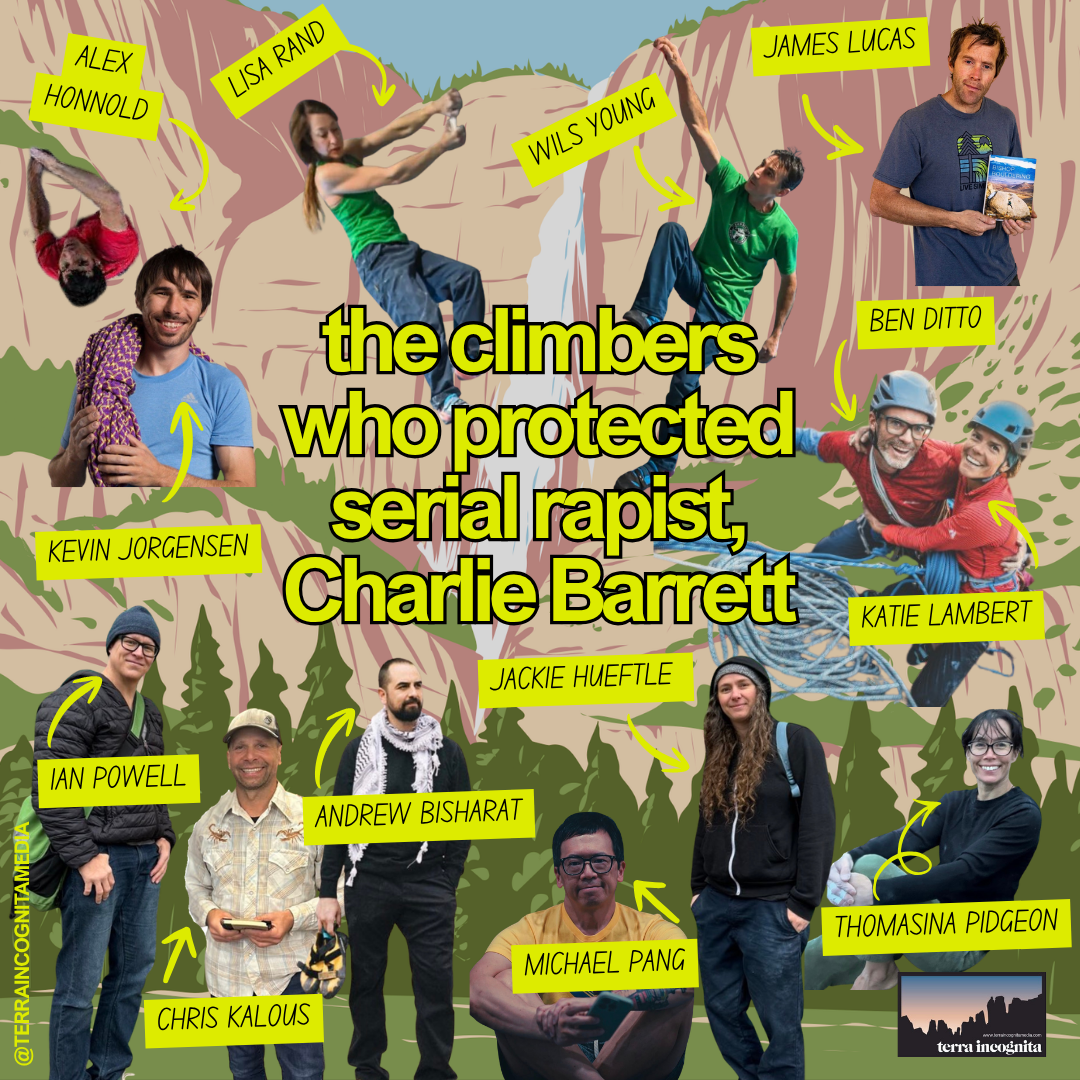
Top climbing and outdoor publications like Climbing Magazine, Outside, and Rock and Ice (when it was around) have historically been steered by men who foment toxic masculine, individualistic, settler colonial propaganda. Specifically, Andrew Bisharat and James Lucas, despite countless attempts from women in the industry to get them to heel, remain staunch in their misogynstic gatekeeping of climbing media. Not only has Lucas garnered a reputation for sexualizing and objectifying women instead of highlighting their climbing skill and prowess, but he was besties with Charlie Barrett, a serial rapist. Lucas shared with Annette McGivney for her Outside expose on Barrett that, “it’s a hard subject to talk about because many climbers feel complicit in what happened. If someone is misbehaving in our community, what is our responsibility to intervene?” Still, Lucas remains confused about how he and other men with the power and privilege they possess could possibly stop rape and sexual assault.
In July 2016, Lucas published a glowing profile of Barrett in Climbing magazine. (It was removed in 2018 after Matt Samet, Climbing’s editor became aware of Barrett’s history of violence). Anette McGivney writes, “Lucas made passing mention of Barrett’s ‘legal troubles’ and detailed his claim that he suffered debilitating panic attacks. These attacks, Lucas concluded, were the source of Barrett’s problems.”
Lucas told McGivney, “Charlie did not want me to put anything about his arrests in the story…My goal was to just focus on his character as a climber. Looking back, that wasn’t such a good idea. But my thinking then was that he was my friend and I wanted to believe he was a good person.” Lucas and countless others knew the full, entire scope of Barrett’s violence. He was charged with domestic violence in 2006 and had been assaulting, harassing, and terrorizing Bonnie Hedlund for years to the point that she had to stop climbing and get off social media.
McGivney reported that in her research she discovered that Barrett, “…was accused of sexually assaulting four other female climbers between 2010 and 2017. Federal investigators told [her] that there could be many more victims who’ve stayed silent. Records also show that during a 14-year period starting in 2008, at least nine criminal protective orders or restraining orders were obtained against Barrett by four women who all said they feared for their lives.” James Lucas and his writing is a prime example of the dangers of Himpathy and how those in positions of power can craft and wield narratives that rally for the support and protection for abusive, violent men. Charlie Barrett may be behind bars now, but what about the other Charlie Barretts who are out there free to continue their harassment, stalking, and assault? How many violent, harmful men are being protected by their friends as I type this? Why hasn’t anyone taken Tim Kemple off his pedestal?
Bisharat similarly refuses to be on the right side of history at every turn. Even his film, Resistance Climbing, felt more like it centered his pathetic character arc from “curmudgeon, washed-up dirtbag” to “guy-who-recognizes-his-American-privilege-in-his-late-30s-and-can-now-crack-a-smile-sometimes.” For several reasons which Wadi Climbing details on their blog post titled, “Why We Didn’t Like the Reel Rock Film ‘Resistance Climbing,’” the film failed to center Palestinians and instead relied on the formulaic outdoor film narrative of a white savior/protagonist who does some soul-searching to achieve self-actualization or “enlightenment.” Instead of using platforms and writing as vehicles to expose injustice and oppression, he centers himself.
When one of Barrett’s survivors, Stephanie Forté, went to Bisharat for support, as well as Chris Kalous, host of the viral climbing podcast, the Enormocast, both men failed to step up. McGivney for Outside reported that, “over the course of three years, Forté had taken strong steps to protect and isolate herself. In 2018, she stopped climbing and invested in a security system for her Las Vegas home. In 2019, she closed her PR agency, not wanting to maintain a public profile. The 2022 death threat pushed her deeper into hiding. She moved to a high-security gated complex and turned down work that required her to appear in public.” After enduring all of this trauma, I can’t imagine what it would be like to ask your friends for solidarity and help only to met with cowardice.
In this paywalled episode of the Runout podcast, Bisharat shares with Kalous that he didn’t know why Forte was coming to him. He recalls telling Forte to go to the police. Kalous and Bisharat conclude that the climbing community at large shouldn’t be held accountable for Barrett’s reign of terror. Instead of speaking truth to power and using their privilege to campaign against a predator, Bisharat and Kalous chose to participate in rape culture by doing nothing to stop it. These are just a few prime examples of the ways in which Bisharat, (who some refer to as the “wallet pisser” for the time he stole a woman’s wallet, blacked out her license with a sharpie, and then proceeded to pee on it before tossing it into the urinal), has always prioritized staring at his own navel rather than actually attempting to make positive change in the industry.
Men like Tim Kemple, James Lucas, and Andrew Bisharat stand in the way of countless, brilliant women, trans, femme, non-binary, two-spirit, Black, Indigenous, people of color creatives who are silenced, harmed, and pushed out of the outdoor media landscape. While generations of us have been disillusioned for decades, there are new climbers and outdoorists coming into the fold looking to be affirmed and welcomed, only to be met with the same, tired stories of white men grunting up rocks on unacknowledged, stolen land that they claim as their “backyards” or “playgrounds.”
From the minute we’re born, we’re indoctrinated into a culture of white, cisheteropatriarchy that tries to convince us that white men are elite geniuses who worked hard for their prestige. In reality, most of these men are mediocre, talentless hacks whose perspectives lack depth and real meaning. Most of their titles and positions are unearned, achieved only through the nepo-bro code of the industry. As women and marginalized genders attempt to survive in this world, we’re forced to disconnect from our intuition, senses, and bodily autonomy. In order to “climb the ladder,” we’re told in various ways that we need to ignore these “covert” (not really) forms of racism and sexism coming from the “big players,” suppress our real emotions, instincts, and intuition, and ultimately disregard our own humanity if we want to secure resources, money, opportunities, gigs, jobs, power, and/or social status.
A few years ago, I was talking to my friend on the phone and offering emotional support as she was going through a rough time with her partner, a cis white man. To protect her and her story, I won't go into detail, but as she was explaining his awful behavior I became hot and enraged on her behalf. She told me about how her family and friends saw this man as an angel who could do no wrong. On paper he was a "great guy." But my immediate thought is that this "paper" was drafted by white supremacist patriarchy. It should be ripped up into tiny little shreds, composted, and made food for mushrooms. Everything she told me was leading me to conclude the opposite of this man.
I gently, but firmly reflected back to her what she was telling me and told her this made me really angry to hear. By the end of the conversation she sounded relieved, validated, and like she had been given permission to feel the emotion that is essential in order for us to be our fully expressed selves: rage. The one emotion that men are allowed to express, but that is so completely off limits for women, femmes, and marginalized genders.
As a kid I always had an easy time tapping into my anger and rage at home, but it took time to be able to express it when I'd step outside. But as I got older, it became so apparent how unjust and unfair our society was. The extreme lengths that people will go to smooth things over when things are absolutely not okay, made me feel crazy.
I had to find an outlet for my rage, so I channeled it into my writing and starting this platform. Terra Incognita Media has been a practice in harnessing my rage and giving myself permission to dare speak the things we're not supposed to say out loud. Once I found out how horribly unhealthy it is to suppress our emotions it was game over. I would make it my life's work to figure out how to navigate any situation without ever having to suppress myself again.
But of course, that's not real life. There are social situations where, because I'm a woman, and I want to get out of the situation alive and without experiencing flak, criticism, or heat, I make "nice." Mostly this has to happen when I'm around my straight, white family and their network. But this is why I take my work so seriously. Because sometimes, even when we know it's not healthy to suppress our rage, we have to in order to survive, especially if you're multiply marginalized.
As a white woman, I walk through the world with tremendous privilege in my ability to express rage and anger and publish words of that nature, and still have yet to receive a serious death threat. This isn't the case for many Black, trans, Indigenous folks, and women of color. I know the power and privilege I hold, and I want to wield it and squeeze it for all it's worth for the betterment of our collective. I wish more of us would wrestle with where, how, when, and what circumstances we may have more freedom to express our true feelings, thoughts, and emotions than we think. We may surprise ourselves.
For example, I know many white men who have come forward to tell me about how awful people like Jackie Hueftle, Ian Powell, Lisa Rand, Wils Young, and Tim Kemple are, only for me to be left wondering: so, where's your backbone? Why haven't you confronted them? Many of us suppress our emotions and truth simply because it might mean not being invited, included, or given the opportunity, even if, truthfully, we could find other friends, other gatherings, and other opportunities. Sometimes, because of our whiteness, we may be surprised to find that we can say the hard thing and still keep our job and/or social standing. So, where is our integrity?
After speaking with many folks who tried to “play the game,” it’s clear that none of us win when we try to align with the way “it’s alywas been done.” Because the way it’s always been done in outdoor media is to listen to the white man in charge and never challenge him, which leads to a loss of ourselves and our authentic expressions. We’ll never build the collectively liberated world we yearn for by continuing to strive for a seat at a magazine or film collective that’s built its legacy on the exploitation, sexualization, and dehumanization of marginalized people.
Tapping into our rage and anger for the ways in which we’ve been sidelined, overlooked, silenced, degraded, and dismissed is crucial in order for us to stop investing in these white, cisheteropatriarchal institutions, organizations, and media platforms. I'm convinced we don't need them. We don't need to half-heartedly perform praise or tolerate their commitment to toxic masculinity and rape culture anymore. We can use our rage as fuel to imagine and build something new and nourishing outside of the confines of white, cisheteropatriarchal institutions.
I invite you to ask yourself these questions:
Who or what do I align myself with and why?
Do the people I surround myself reflect my values and the world I want to build?
What would happen if I spoke or behaved in ways that were more true to myself, my beliefs, and my vision for the world?
May we feel and process our rage so that it can be transformed into fuel for building a world where we all belong and thrive.