'Bolt Wars' and First Ascents: Are These Manifestations of Ongoing Colonization?
'Snake Dike' sparks another climbing-bro hissy fit begging the perpetual question: why are men?
A white man’s opinion of the bolting, and subsequent un-bolting, of Snake Dike is irrelevant. I want to hear from Jolie Varela of Indigenous Women Hike and other native folks of the surrounding lands. Varela understands the impacts of climbing better than most. Because her homelands of Payahüünadü (the place of flowing water), so-called Bishop, California, include some of the most popular climbing destinations, like the Buttermilks, Owens River Gorge, and the Sierras, Varela has tried to work with climbing organizations to end the erasure of Indigenous voices and perspectives in outdoor recreation. However, those collaborations with prominent climbing organizations have repeatedly caused more harm.
Back in the spring of 2019, Varela, Kris Hohag of Legendary Skies, Climb the Gap members, and Kathy Bancroft, an Indigenous elder who fiercely fought for the land and water (she devoted every last second of her life to protecting her homelands from extractive entities like the Los Angeles Department of Water and Power before she passed in February of this year), attended the American Alpine Club’s Craggin’ Classic. What was supposed to be a vibrant, engaged panel discussion among these leaders instead became tokenization, exploitation, and more erasure.
“The AAC is not doing ‘pretty good.’ They’re actually doing worse than previous years and [Chris Schulte’s] post is glorifying the atrocious job they did,” Varela shared. “Our voices were erased and our time was wasted on Friday night. I’ve been asking this org to do better for three Craggin’ Classic events now, and they cannot get it together. You cannot use us as props to make it seem like you care about Indigenous presence and community being involved when you don’t show up or give us the platform to speak.”
Since founding Indigenous Women Hike, Varela has spent nearly a decade educating the public about the true Indigenous place names and histories of beloved trails and outdoor destinations. She is particularly known for bringing John Muir’s racist, anti-Indigenous legacy into the mainstream conversation. Varela created Indigenous Women Hike to help reclaim her people’s lands.
As Tazbah Rose Chavez writes, “Our Nüümü (Paiute) elders have called the [John Muir Trail] the Nüümü Poyo—the People’s Trail—for as long as I can remember, as it’s part of a network of routes in the Sierra that have been used by tribes for hundreds of years. In walking the more than 200-mile trail, the women, my friends, will honor their ancestors and restore the region’s Indigenous place names.”
Despite Varela investing countless hours of emotional, intellectual, spiritual, and physical labor educating climbers and climbing organizations, it became clear that climbers are among the most entitled and defensive recreation groups, pushing Varela to step back from the climbing world. Time and again, Varela has been met with vitriol, gaslighting, harassment, and aggression for speaking out about the entitlement and white supremacy culture embedded in climbing. Still, Varela remains strong and unapologetic in her convictions, and at times the white arrogance is so glaring that Varela can’t help but comment.
Recently, Varela took to social media to share her thoughts on the bolting debacle of Snake Dike. When she initially came across the article, “'Snake Dike' Chopper Explains Why He Removed the Route's New Bolts,” she was hopeful. “My first thought was, ‘how cool, somebody removed some bolts from sacred land, from native land.’” But disappointment washed over her when she realized the bolts had been chopped for reasons completely unrelated to protecting sacred, Indigenous land.
“Snake Dike” is considered a “Yosemite classic” in the rock climbing world. It’s graded 5.7R. Grades help climbers assess a route’s difficulty and risk, and decide whether they can or should attempt it. Although 5.7 is often considered “beginner-friendly,” this route can feel closer to 5.9, or veer off route and you’re suddenly in 5.10 territory, which can challenge newer climbers. In this op-ed published in Climbing, Sam Miller writes, “…guidebooks and even Mountain Project comments, as detailed as they can be, often fail to tell the full truth. I for one have been subject to the unfortunate folly of getting on the five star 5.10 in a new area only to find that it really is 5.11+/12- (due to grade inflation), horribly protected, and has death fall potential 30 feet above a boulder field.”
The “R” in “5.7R” stands for “run out,” which means the lead climber must climb significant lengths without protection. One misstep or fall could be detrimental. Experienced climbers know that when you see an “R” rating you should avoid falling at all costs because it could mean serious injury or worse.
Because “Snake Dike” has some protection, albeit sparse, it wasn’t given an “X” rating. “X”-rated climbs are the most dangerous, with protection that’s nonexistent or unreliable. But while “Snake Dike” technically has a few points of protection, it seems irresponsible not to label it “X.” There are sections of up to 100 feet where placing gear or clipping a bolt isn’t an option, dramatically increasing the risk of serious injury or death. A tragic accident in 2021 underscored that danger when Anna Parsons fell 80 feet while leading “Snake Dike,” and doctors were forced to amputate her foot, resulting in over $1 million in hospital bills.
The route was first climbed in July 1965 by Eric Beck, Jim Bridwell, and Chris Fredericks. Beck has long supported adding more bolts to the route’s runout sections, and Parsons’ accident intensified his plea. In a Facebook post, he wrote, “There was a recent and very sad accident on the Snake Dike of Half Dome…We left the route with single belay bolts and two protection bolts. We realized this was totally inappropriate for a moderate route…I am once again asking, add some more bolts to the Snake Dike.”
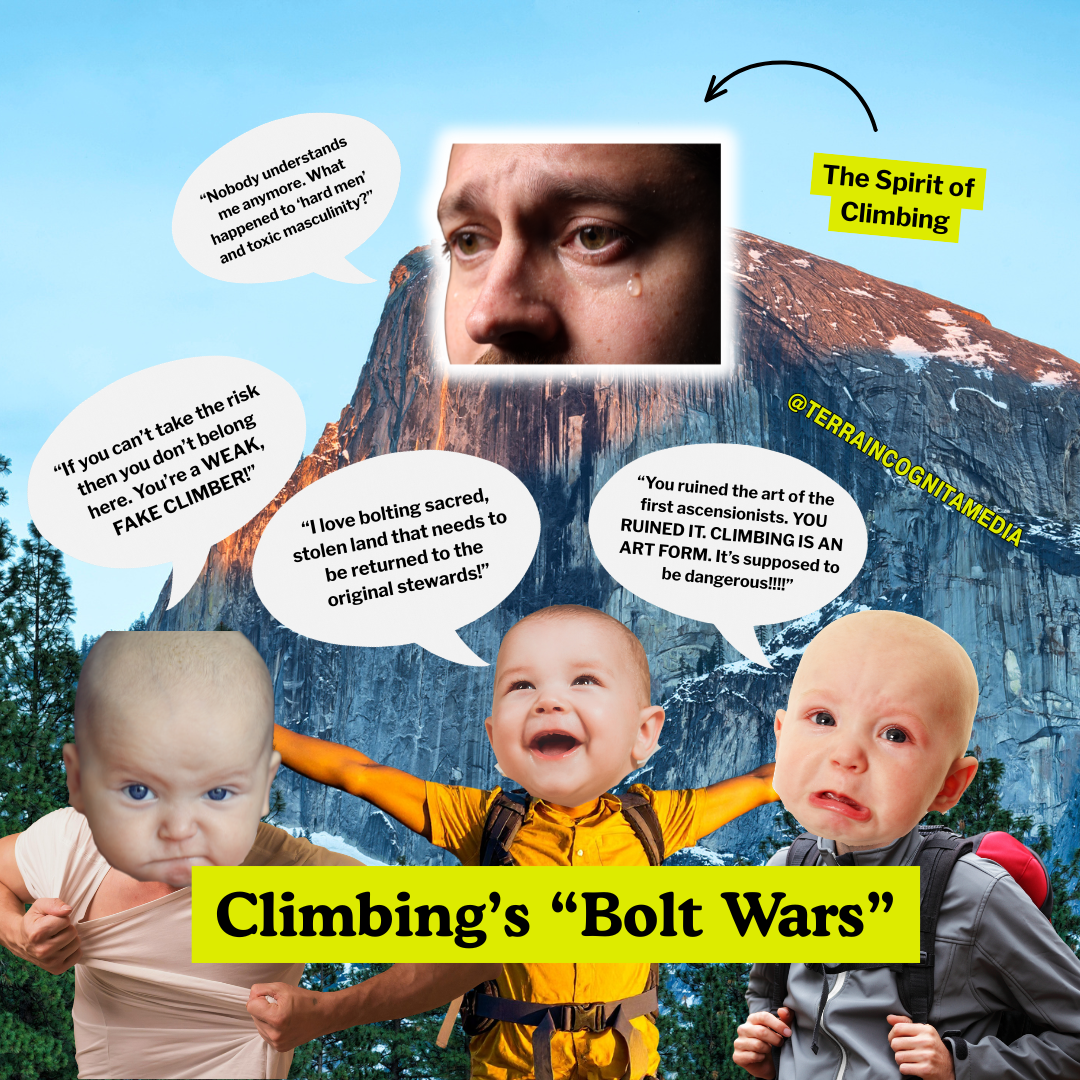
“Snake Dike” is one of many routes that hysterical, white male climbers lump into the “bolt wars.” In these debates, born of white navel-gazing and boredom, two styles of climbing are often pitted against each other: sport climbing, which relies on bolts fixed to the route, and traditional, or “trad,” climbing, which involves bringing your own gear, placing it for protection, and removing it as you climb. Trad climbing is often associated with “hard men”—those who gatekeep, glorify risk-taking, and don’t consider it “real climbing” unless there’s a chance you’ll fracture an ankle or get a concussion. Some argue that adding bolts to routes like Snake Dike undermines the “essence of climbing,” the “bones of the sport,” and the history of the “first ascent.”
Former Rock and Ice editor Francis Sanzaro wrote in October 2022 in an op-ed hilariously titled, “Climbing Should Be Dangerous,” arguing, “The better you get at climbing, the better you get at understanding and managing fear’s various manifestations. And what a magical feeling it is when fear is replaced by performance. We start to move with facility, without needless anxiety. Our heartbeat calms. We start to climb. That’s the climbing game. That’s why climbing is dangerous. That’s why so many climbers—I’m one of them—are adamant it stays that way.” This proves, yet again, that men should be banned from getting philosophy degrees, because it only amplifies their hubris.
Climbing bros never cease to amaze me. They’ve racked up countless bylines in reputable publications showcasing their expertise in writing sentimental slop that romanticizes toxic masculinity. Both camps, the climbers who advocate for increased protection on popular routes and those who staunchly defend leaving routes in their original condition, speak as if they’re operating in a vacuum. But climbing exists in the context of ongoing colonization. This make-believe “bolt war” is meaningless because no one has considered how the original stewards feel about climbing on these unceded, stolen lands.
Varela explains that she learned the 16 bolts added to “Snake Dike” by climber and guidebook author Eric Sloan were removed by two climbers who believed the route should remain in its original state—accessible only to those willing to accept the risks of running it out. “What it sounded like is that the bolts were tarnishing the route, and not just anybody can climb the route,” Varela says, laughing at the ego of the bolt-cutters, “…and that accessibility issue is like a whole other thing…so you, a climber, didn’t want more climbers to come and climb the place where you climb at, and so you remove the bolts. Okay, interesting.”
“The culture of climbing is colonization,” Varela continues. “You guys are settlers. When you bolt those rocks it’s like you’re staking a flag in that space and that is native land. We have ancestral claims to that land, along with many other tribes.”
It’s been 250 years of white entitlement, possession, violence, stealing, claiming, hubris, and rape of the land and Indigenous peoples. White men are still inventing their own wars out of boredom. Climbers talk about “ethics” in a vacuum, as if we aren’t uninvited settlers/colonizers on stolen land. As Varela points out, “establishing” a route, nabbing a “first ascent,” and “developing” a climbing area are all rooted in a colonizing mentality.
“All national parks, all public lands hold the creation stories, burial grounds, ceremonies, traditional foods of Native people who were removed violently to designate those lands as public,” Varela explains. “So, you’re climbing, you’re hiking, you’re recreating on Native land that Native people were forcibly removed from.”
The hysteria around bolting, or chopping bolts, becomes trivial when weighed against Varela’s perspective. She argues that debates over “ownership” of a route or space, and over whether to add or remove bolts, ultimately center whiteness. These “bolt wars” erase Indigenous history and voices.
“Nowhere in that article does it mention Native people,” Varela implores. “Because if we’re going to talk about ownership, climbers don’t own shit…We need to also talk about the Indigenous history of those lands. The Indigenous history of those lands span thousands, and thousands, and thousands of years—not when they were bolted in 1965, not when they were designated public lands. Colonizer history is this tiny, tiny little blip of history on this timeline…and here we are in Climbing Magazine having this ‘fierce debate’ over ownership of the land, and it is ridiculous. Do you guys understand how ridiculous you sound?”
Darion Maltby, a 30-year-old climber from the Bay Area and one of the two choppers told Climbing Magazine, “The climbing tribe’s voice on this is clear…Sloan’s bolting is anathema to the spirit of Snake Dike in particular and of trad climbing in general.”
“The climber tribe is not real,” Varela says, exasperated. “That is not a real fucking thing. You want culture so bad. No, there are real tribal nations of those lands, and what about our voices? Those are the real tribal voices that matter. There is no spirit of trad climbing, and no spirit of the Snake Dike route. That land does have a spirit, but it has nothing to fucking do with climbing.”
Varela goes on to describe a passage from Mark David Spence’s Dispossessing the Wilderness, in which he writes about the Hayden expedition, which set out on July 29, 1872, motivated to be the first to summit the Grand Tetons, believing that no other human had ever done so. Nathaniel Langford, one of the so-called explorers, wrote in his diary, “On one of the adjoining buttresses we found a curiosity in the shape of granite slabs piled up on end, in circular form, 6 feet diameter…the space filled in with disintegrated granite, eroded from these vertical slabs. This was probably done hundreds of years ago…We were glad to come down from the extreme summit and find shelter in this enclosure.”
This structure is now widely known as “the enclosure” and draws people from all over to see it in person. According to this flier from the Wyoming State Historic Preservation Office, “The Crow explained that the rock features were the fasting beds of supplicants who were seeking a guardian spirit helper.” You can learn more about the enclosure here, but be warned: it’s told through a white man’s perspective, and he uses the word “strange” to describe the structure. Strange to who? It’s important to question the language we use when describing elements of others’ cultures, because something is only “strange” when we’re unfamiliar with it. This framing treats the white gaze as “normal,” or the “default,” and encourages a myopic worldview that should be avoided at all costs.
“The fucking audacity—to believe that native people have lived on this land for thousands and thousands of years prior to colonization, and that we didn’t explore and connect to our own homelands,” Varela says, describing the explorers’ surprise at finding this structure. “There are no fucking first ascents. Get that out of your mind. We have been all over these lands, to the top of mountains, and to think that we have been a part of this land for that long and to not have done that is colonization.”
Speaking to the colonizer’s possessive impulses, Varela explains, “And even when we named places they were descriptive of the places. We didn’t put our names on them.”
“And this is where I’ll end,” Varela says, “Native people, we, are still very much connected to Ahwahnee, or so-called Yosemite, or public lands, our ancestral lands in general. We are still gathering, holding ceremony, gathering our traditional foods. We are very much still a part of these lands. We’re still loving and caring for these lands, and climbers, recreators, have a lot to learn. A lot.”
By treating the chopping of Snake Dike’s bolts as inherently newsworthy, without addressing the colonizing implications of the broader bolting/de-bolting debate, Climbing Magazine only perpetuates climbing culture’s white entitlement and hubris. At the same time, this obsession with “first ascents” prioritizes getting to the top, summiting, and pushing the limits, over everything else. It’s a purely individualistic endeavor that assumes the person who “establishes” a route has the right to name it. As Varela has pointed out, that practice disregards the original stewards and their experiences of forced removal and dispossession, histories that we, as white people, still benefit from today.
As white people in particular, we need to reconsider our relationship to this land—to climbing, bolting, and so-called “first ascents”—when we’re uninvited settlers and were never the first. We should ask whether bolting is ethical in the first place. And I’ll cheat and give you the answer: no. Climbers, sport and trad alike, can be remarkably entitled to assume we get to decide what’s ethical or not, if bolts should be placed or removed, and if so, where and how they’re placed.
The white men who dominate climbing consistently talk about the “spirit” of climbing, but in reality we’re far removed from any spiritual connection to the land because we approach it with a colonizing mentality. As Varela said, we want culture so badly, and we have to accept, and importantly, grieve, that we don’t have one. More importantly, we have to stop making that desire everyone else’s problem. The real spirit of western climbing is entitlement, hubris, toxic masculinity, and patriarchal aggression.
Indigenous wisdom sees the land as a living, breathing, sentient being; too often, we treat it as something from which to extract pride, glory, reputation, status, and ego. Our relationship to the land too often begins with entitlement and control, and debates about “ethics” in climbing fall flat when we ignore the original stewards and what they think about our actions on their land. Do we even have permission to be there? What impact do we have, as white people, taking up space on sacred lands—places where Indigenous people have restricted access because of the systems of oppression we live in?
As white people, we dominate these landscapes and the sport of climbing not because we’re more spiritually connected, but because, in a white supremacist society, we have the privilege, power, access, money, time, and resources to participate. The way some climbers get up in arms about bolting (making a climb less dangerous and therefore more accessible) is rooted in a white supremacist impulse toward exclusion, elitism, and control. Many argue that trad climbing is less damaging, more environmentally friendly, and more aligned with Leave No Trace ethics. But while bolting is an assault not only on the rock but also on Indigenous sovereignty, trad climbing is no better. All climbing “leaves a trace.”
With that in mind, we should focus on how we can disrupt this intergenerational cycle of Indigenous erasure and violence, and instead leave a trace of mutuality, reciprocity, care, and solidarity with Indigenous peoples.
Some suggestions for taking action:
Follow, support, share, and donate to the work of Jolie Varela and Indigenous Women Hike.
Stop bolting new routes, “establishing” new climbs, and “developing” new climbing areas.
Start conversations about the real ethics of climbing by considering Indigenous perspectives, voices, and wisdom.
Pay a land tax to the original stewards of your area (make a recurring payment to local Indigenous leaders, groups, activists, organizations, etc.).
Learn the full Indigenous and Black history of the places you live and visit.