Himpathy for the Devil: The Climbers Who Protected Serial Rapist, Charlie Barrett
“Himpathy” has a chokehold on our society, and it is pervasive in climbing. Coined by philosopher Kate Manne in her 2017 book, Down Girl: The Logic of Misogyny, Himpathy describes the disproportionate and excessive sympathy often extended to privileged men who behave badly. You can find instances of Himpathy in climbing spaces as easily as you can find an upper-middle-class man romanticizing “rugged” “van life” while living out of a custom Mercedes Sprinter van, complete with Starlink satellite internet, just to log into Slack and merge code for a trillion-dollar tech giant.
I first learned about this concept from the podcast series, MEN, in which hosts John Biewan and Celeste Headlee highlight Janey Williams’ story about her loved ones’ responses, or really lack thereof, when she confided in them that she was sexually assaulted by her good friend, Mathew. Williams also published a podcast series of her own, This Happened, a gut-wrenching account of how Himpathy facilitates rape culture. In episode 3, Janey’s friend recalls having a “determined obliviousness” to Mathew’s inappropriate and creepy behavior. This describes exactly what happens in climbing culture when a prominent climber is accused of sexual assault.
Himpathy highlights how (mostly white) men garner sympathy among peers and even in the court system after enacting violence such as sexual assault. It has become etched into our psyche like an impulse. Its ubiquity often goes unnoticed or is taken for granted because it is part of the status quo. Over and over, we hear about, or experience for ourselves, judges, friends, and family finding a way to excuse and pity the perpetrator’s behavior and experience instead of centering survivors. We’re conditioned to prioritize the perpetrator’s feelings, well-being, and future, in effect overlooking the impact on those who were victimized.
Climbing is full of abusive men protected by the “determined obliviousness” of the people around them. A white, male-dominated sport that cloaks itself in working-class aesthetics and pseudo-humble minimalism, despite requiring significant privilege, wealth, and resources to access, climbing attracts lonely and bored (read: toxic masculine) men desperate for “brotherhood.” Starved for genuine, intimate camaraderie but lacking the emotional maturity and depth to nurture those relationships, men instead recreate toxic power dynamics in climbing spaces. They form cult-like (trauma) bonds while reinforcing hegemonic codes of masculinity that go unchallenged. Sprinkle in shared adrenaline alongside the media’s glorification of top athletes as “Gods,” and what else would spawn but fanatical devotion?
White male supremacy conditions men to be emotionally repressed, dominant, and violent. Climbing, like most outdoor extreme sports, has historically functioned the same way, punishing anyone who deviates from the invisible rules of toxic masculinity with intense scrutiny, ridicule, shame, and ostracism. As we saw recently in the Dean Potter docuseries, The Dark Wizard, climbing culture normalizes abuse and frames unequal and stifling power dynamics as just another day as a “dirtbag.” Like a cult, climbing fosters charismatic leaders that members are pressured to fawn over, or risk being cast out. If you ask questions or challenge leadership, you’re seen as a threat.
Peter Pan, the Lost Boys, and the Himpathetic Response to Charlie Barrett
What should be a hobby, climbing in some circles functions like an obsessive subculture that creates micro-celebrities who rely on, and demand, our worship. A loyal group of Peter Pans forms, eager to please whoever holds the most social cachet. It’s a “cool kid” club of grown men who hate the suburbs they were raised in and treat refusing to pay for camping in Yosemite as an act of rebellion and “sticking it to the man.” If you want to be accepted, you’ll “go with the flow,” obey existing norms, and prioritize group cohesion above all else. Their loyalty runs so deep that they refuse to break rank even when someone in the group commits violence. Their silence, pity, and defense become complicity.
In healthy, mature adult relationships, you can confront friends and peers and hold them accountable. Healthy, mature adults also do not excuse or permit violence. But climbing’s affliction with Peter Pan Syndrome and hero worship, combined with its deeply entrenched toxic masculine, white male hierarchies, requires compliance and breeds the perfect conditions for unyielding Himpathy.
Audit climbing documentaries, films, articles, etc., and you’ll find the leading white, male figure is often described as a Peter Pan or even self-identifies that way. While Peter Pan is the fearless leader of the Lost Boys, he never actually has to take responsibility for his own actions or the group’s. Keeping things light and on the surface is part of their code. The irony is that the Lost Boys prize freedom, yet face castigation the moment they step out of line or disrupt the fellowship. Addressing harm or questioning leadership is treated as a threat to the fraternal order. After all, Peter Pan and the Lost Boys are naive, innocent children who just want to rebel, romp, and play. They’re portrayed as faultless, determined to live in eternal youth. But Peter ruthlessly banishes, or “thins out,” boys who start to grow up because it breaks the rules.
We see this unscrupulous Peter Pan ethos in climbing, which incubates the perfect conditions for coaches, climbing gym employees, and elite climbers to abuse their “idol status” inside the “boys club” and remain protected from consequences. Through this well-oiled, censored, submissive, and dutiful network, these idolized Peter Pans can rely on the iron-clad loyalty of their Lost Boys to conceal predatory, perverted, and corrupt behavior.
In the case of Charlie Barrett, the climber sentenced to life in prison in 2024 for more than a decade of sexual violence, harassment, and intimate partner violence, the Himpathizers came out of the woodwork both before and after his conviction. His violent history, and the people who enabled him, were brought to light in an exposé published in Outside, “How Did This Climber Get Away with it for So Long?” written by Annette McGivney. The surge of pity and “determined obliviousness” that shrouded his violence still lingers in the climbing world today. The way the people around him protected and insulated him is exactly why he was able to “get away with it.”
Character Letters from People Who Lack Character
Despite his known history of intimate partner violence and sexual assault, he still had, and has, a network of allies across the country, especially in popular climbing destinations like Yosemite, Bishop, Las Vegas, and the Red River Gorge.
The stomach-turning Himpathy for Barrett is laid bare in the enthusiastic character letters submitted on his behalf. Friends, family, and well-known climbers wrote to the California judge, hoping to save Barrett from life in prison because they believed it was too harsh a sentence for a guy who climbed so hard.
While researching this article, I read a few transcripts from Barrett’s trial. Refusing to believe survivors who have bravely come forward to hold a violent man accountable is horrific enough, but the fact that these people could still justify his behavior—going so far as to defend him at length in a typed-up letter even after he was found guilty—is a testament to the pervasiveness of rape culture.
On February 1, 2024, an anonymous survivor posted on Mountain Project writing a plea to Barrett’s network to not write character letters for him. At the time, Barrett’s friends were rallying to protect him:
“If you are his friend, and you want to write a character reference for him to the judge (which is what people in Mammoth are rallying to do even as you read this), that is exactly what he has worked so hard to get you to do. However, before writing that letter about what a great guy he is, maybe consider what it would be like to sleep with him, to have a fun relationship and boulder together or climb in the desert and watch him annihilate 5.13 trad. Mesmerizing, right?
Then consider him punching you in the stomach because you said or did something "wrong." Then consider his hands around your neck, unprovoked, and then losing consciousness. Then consider perhaps how close you were to losing your life, on "accident" because his eyes glazed over and he didn't know when to stop. This is the character reference angle you don't have if you are "just friends" and thank goodness you don't. Because it is horrific. Maybe put that pen down, stop writing that letter, and imagine what that could feel like. Then maybe write "I'm sorry" to his victims instead.
His crew blackmails witnesses online, and publicly shames them (Stephanie Forte is a good example). He manipulates his friends and family (his dad) into calling and intimidating witnesses. Behind bars, his campaign of proving himself innocent will continue. He will continue to manipulate people into befriending him, dazzling them with his funny jokes and convincing them to be his arm to gut punch his victims from behind bars.
If exonerated, he will stalk the victims and actively try to ruin their lives himself; after all, someone will have to pay for him being in prison without bail for over a year. This trial may serve justice, but does not end the nightmare.
I want to thank Officer McGee for risking everything, including her and her family's well being to investigate Charlie. He has been exceptionally cruel to her and her loved ones in this process. She is very brave for taking him on and should be honored for her service to the community.”
The fear that he is just as dangerous behind bars was echoed in a message I received from someone who knew about Barrett’s violence, warned people about him, and worked to do everything they could to protect the survivors. This person corroborated the survivor’s account above in which they told me that they experienced not just Barrett’s violent harassment, but also his friend’s and family’s terrorizing phone calls and messages. They listed the same tactics described above: harassment, bullying, intimidation, and blackmail.
In this article published on The Conversation titled, “Character references tell a court you’re a good person. Why are convicted rapists allowed to use them?” Vicki Lowik and Amanda-Jane George explain that character letters can be “…re-traumatising for a victim-survivor to hear positive character comments about someone who has pleaded guilty or been found guilty of assaulting them.”
And yet people still mobilized to defend their serial rapist friend.
The letters submitted on behalf of Barrett constitute violence, revealing more about the author’s character than Barrett’s. The following people are rape apologists:
Michael Pang, a climber and doctor based in Phoenix, Arizona, wrote in his character letter for Barrett, “The more time anyone spends around him the more they’ll see evidence of his kindness and compassion, reflected in his everyday actions and attitudes...I’ve seen him take better care of his health since becoming sober, and I know it has improved his struggles with anxiety and depression.”
Pang also took to Instagram in 2021 to promote Barrett’s bouldering guidebook writing, “ Back in stock! Bishop Bouldering II and Tuolumne Meadows Bouldering, 2nd edition - from the venerable Charlie Barrett.”
Venerable: someone or something commanding deep respect, honor, or reverence because of their great age, dignity, historical importance, or religious significance. Nothing about Barrett has ever been venerable, but this reveals a lot about Pang’s character and the company he likes to keep.
Katie Lambert, a professional climber based in Bishop, California, (who blocked me on Instagram years ago), wrote in her Canva-designed character letter that Barrett, “…was known locally and within the California climbing community as very gifted and talented rock climber. He was polite, very supportive and focused on rock climbing…I have also witnessed him suffer from bouts of depression and anxiety; a diagnosis of bipolar disorder was given to him…I have never felt unsafe or threatened by Charlie even though I know he has a storied past. I know that he shows tremendous potential to be of good in society.”
Lambert likes to hide her allegiance to white, cisheteropatriarchy behind the fact that she works with Indigenous youth, but she has a “storied past” of failing to actually be in solidarity with Indigenous activists and leaders in Payahüünadü who are fighting to uproot settler colonialism and white supremacy in the area.
Lana Hansen, a registered nurse in Mammoth, California, wanted the court to know, “Charlie is one of the kindest men I have ever met. He would give you the shirt off of his back if you needed it. I have never witnessed him show anger towards anyone, especially towards a woman.”
Make sure to ask for a different nurse if you’re ever at Mammoth Hospital.
“From the beginning, Charlie always maintained respectful boundaries towards my friends and I, one of whom he briefly dated,” wrote Tess Vining.
Thomasina Pidgeon, a climber based in Squamish, received valid criticism from the climbing world for submitting her character letter in which she wrote, “I am writing on behalf of an old friend of mine, Charlie Barrett, whom I’ve known for over 22 years. I believe Charlie to be a good person. Charlie is kind, open, and one of the gentlest people that I know and trust…Charlie’s own business, writing guidebooks has been quite a success. This isn’t an easy feat by no means as it takes great patience and dedication. Yet, Charlie managed to write several guidebooks to well known climbing areas like Tuolumne and Bishop, much of this on his own, which is a great inspiration. Despite being incredibly smart, hardworking and having one of those memories that can recall events easily, he remains down to earth.”
To translate these prime examples of Himpathy: This man never hurt me and I never saw him hurt anyone else. Therefore, he’s not a threat and these accusations are false. He writes guidebooks, has a good memory, and is so down to earth. This is evidence that there’s no way he raped or violated all of these women that have come forward.
The implication of this “logic” is that if these people never felt unsafe or threatened by Barrett, how could anyone have? If we follow that logic to its conclusion, we’d have to say Epstein must be innocent because he hasn’t assaulted me. By this standard, the moon landing must be a conspiracy because I never witnessed it firsthand. And if Barrett being a strong climber is evidence of innocence, then Johnny Depp being great in Pirates of the Caribbean means he could not have committed violence against Amber Heard.
To be clear, I stand in solidarity with Epstein survivors and Amber Heard. There’s no excuse for Himpathy and it’s crucial to learn how to recognize it because it’s one of rape culture’s most sinister weapons.
Featured on the Unmute Podcast with Myisha Cherry, Kate Manne explains how women, especially white women, can often be the most persistent jockeys of Himpathy. “I think about white women as really just socialized and trained and set up to be incredibly sympathetic to dominant social actors in the form of white men who are powerful,” says Manne. “…there’s at least some empirical evidence, and I’d like to see more, that women are actually, especially white women, can be even worse when it comes to Himpathy because of our socialization to be more empathic...I have a feeling that it does interact with feminine socialization to make Himpathy at least as bad, if not worse, in women.”
The himpathetic “logic” behind these character letters relies on gaslighting and victim-blaming. Himpathy is a deeply insidious phenomenon in which the perpetrator becomes the victim of their own crimes. People are primed to do this for many reasons, one being that the United States was founded on this rationale (framing Indigenous people as threats to “Manifest Destiny” and “civilization”), and it continues through DARVO tactics (framing the Settler Colony of Israel as the victims of Palestine while Palestinians are experiencing ongoing genocide).
Developed by Dr. Jennifer Freyd, DARVO stands for “Deny, Attack, Reverse Victim and Offender.” It describes how perpetrators of violence, and often their supporters, deny that harm took place, attack the victim’s credibility, and twist reality so the offender becomes the victim.
Many himpathizers, in a desperate attempt to discredit the survivors, will engage in the DARVO tactic of ringing the alarm for “false reporting.” However, according to the National Sexual Violence Resource Center, “the majority of sexual assaults, an estimated 63 percent, are never reported to the police (Rennison, 2002). The prevalence of false reporting cases of sexual violence is low (Lisak, Gardinier, Nicksa, & Cote, 2010), yet when survivors come forward, many face scrutiny or encounter barriers.”
Himpathy and Scapegoating Mental Health Issues
Pang and Lambert were among many who wanted to make sure the judge knew Barrett was such a talented climber and a good spotter for those scary highballs, and that even though he was struggling with mental health, he was working on it. Barrett was given a generous amount of wiggle room for his “storied past.” If it was up to his friends, he would’ve been given a bed in the psychiatric ward. They would visit him with balloons, homemade soup, and books written by Jordan Peterson. This way he could still contribute “positively” to the community by publishing another guidebook.
Invoking mental health issues happens like clockwork when a white man is accused of sexual violence, or any harm at all. Mental health is frequently wielded as a scapegoat for a white male’s harmful behavior, as if he’s a toddler having a tantrum because his juice spilled. We’re expected to look on with tender eyes and coo at him. Again, I would point to The Dark Wizard as a prime example.
Blaming mental health issues for someone’s violence is not only wrong, it’s ableist. As Scott M. Bock, Founder and President/CEO of Riverside Community Care, writes, “People need to recognize that mass violence is taking place because of anger, homophobia, and racism – not because the killers are mentally ill.”
More often than not, those who struggle with mental health issues are the victims of harm and violence, not the perpetrators. Lambert’s choice to obscure Barrett’s history of violence by minimizing it as a “storied past” is a slap in the face to survivors of gender-based violence. According to this article published in Time, “Only about 4% of interpersonal violence in the United States can be attributed to mental illness…yet close to 40% of news stories about mental illness connect it to violent behavior that harms other people.”
There’s a reason why rape is a weapon of war. It has long-lasting effects on one’s mental, emotional, physical, and spiritual health. According to this article published in the National Library of Medicine, “Among U.S. women, the adjusted odds of experiencing asthma, irritable bowel syndrome, frequent headaches, chronic pain, difficulty sleeping, activity limitations, poor physical or mental health, and use of special equipment (e.g., wheelchair) were significantly higher for lifetime rape victims compared with non-victims.”
Even more so, “Although survivors of sexual assault are remarkably resilient, research suggests that survivors are at increased risk of developing mental and physical health difficulties after the assault, including post-traumatic stress disorder,” as reported in this article published on the U.S. Department of Veteran Affairs website.
But sure, let’s worry about his future, his reputation, his well-being.
In Rape Culture, Toxic Masculinity and Himpathy Allow White Men to be Both Rugged Individuals and Faultless Babies
Much of the criticism I received in 2018 for calling out Alex Honnold’s egregious toxic masculinity in films like Free Solo can be filed under Himpathy. Living in a cis, hetero, white supremacist patriarchal society means we’re conditioned to pander to the experiences, perspectives, desires, needs, wants, and demands of white men.
Whether it’s your family giving your toxic ex the benefit of the doubt, to people trying to convince me that Alex Honnold’s pseudohostility toward his wife, Sanni McCandless, is actually just his autism, to the way James Lucas writes apologetically about Charlie Barrett (more on that later), to the way Reel Rock featured the film, Cobra and the Heart, about a man who abandoned his partner and newborn baby for 15 years and framed it as a heroic redemption story, Himpathy underlies so much of of the stories we tell ourselves.
Himpathy is a function of white supremacy and for the most part only works in favor of white men. If a Black man who commits violence is ever met with outsized sympathy, as Cherry and Manne discuss on the Unmute Podcast, it’s most likely because his victims aren’t white women, as we’ve seen with R. Kelly, who victimized mostly Black women, and Clarence Thomas, who victimized Anita Hill. But more often than not, Black men and men of color who commit sexual violence are put on blast in the media, reinforcing the anti-Black stereotype of “super predators.” We never have to look far back in history to see a white man escape accountability for the harm they’ve caused. Instead, the justice system too often finds their victim at fault.
In a society brainwashed by the myth of the “rugged individual,” where we’re told our outcomes are solely the result of our own actions, where underpaid, exploited, and over-worked low-wage workers are blamed for their financial reality and billionaires are praised for their “business smarts,” the moment a white man is brought to justice for societal or interpersonal harm, the narrative shifts. His humanity is emphasized. The violence he’s committed is framed as a “mistake,” and everyone around him pivots to countless systemic or contextual excuses.
Suddenly, the outcome was out of his control and he can’t be held accountable for the violence he caused. He is absolved like a child who didn’t know what he was doing. He acted on impulse, not reason. And it’s just so uncharacteristic of men to behave like that, right? Wrong. In fact, if someone has committed sexual assault once, there have likely been other instances, and there will likely be more in the future.
This is the unsurprising bedrock of the society we live in where the U.S. government, along with Argentina and Israel, were the only three countries to vote against a UN resolution in March 2026 that sought to condemn the transatlantic slave trade as “the gravest violations of human rights in human history,” as Assembly President Annalena Baerbock put it. It’s no surprise that a country that votes against reparations for Black people seeks to staunchly defend and absolve white men at nearly every turn.
Rape Apologists in the Climbing Community Must be Held Accountable
Rape apologists are still active in the climbing “community” today. An anonymous source sent me a DM on Instagram revealing that, “Jackie Hueftle and Ian Powell of Kilter Grips are strong Charlie Barrett supporters. Lisa Rands and Wills Young, who own Synergy Climbing in Chattanooga, TN, are in the same boat.”
All four people named are deeply embedded in the climbing scene. Since founding Kilter Grips, Hueftle and Powell have expanded their business by building Setter Closet, which provides holds, route setting, and consulting services. Brands including Kilter, Haptic, Urban Plastix, F-Bloc, Union, Unleashed Climbing, and Sup’r Climbing fall under the Setter Closet umbrella.
Concerned their businesses would be “canceled,” Powell told my source that he, Hueftle, and their friends Lisa Rand and Wills Young felt they could not speak their minds or publicly support Barrett without taking a hit (assuming he’s referring to his bottom line). In a 2022 interview published in Climbing, Powell admits, “I’m still broken-hearted that I don’t climb as hard as I want…”
So, naturally, he started a business, gained power and prestige, and then used that power and prestige to support a serial rapist. Miserable white men (and women) support other miserable white men. That’s what keeps the dam of white supremacist patriarchy churning, but it’s time to throw a wrench in it.
Hueftle built her reputation as one of the first women to set high-level competitions in the USA. As a current board member of Bolt and Revolt, a 501(c)(3) nonprofit whose mission is to create equitable opportunities for women, non-binary, trans and genderqueer people in the setting community, and as someone who has sponsored multiple competitions and setting clinics for women, trans, and genderqueer people, Hueftle projects an image of someone committed to creating safer spaces inside and outside the climbing gym. However, she supported Charlie Barrett during his trial and continued to do so even after he was found guilty. Hueftle was among several of Barrett’s supporters who harassed and tried to discredit the survivors who came forward by sending them intimidating, abusive text messages.
This is exactly why many survivors feel hesitant to speak out. Journalist Jane E. Brody writes that, “More often than not, women who bring charges of sexual assault are victims twice over, treated by the legal system and sometimes by the news media as lying until proved truthful.” And if not the news media, then the stronghold of people, Hueftle and others, rushing to the assailant’s defense.
Another anonymous source reached out via Instagram and shared, “It wasn’t just a few men who knew how violent he is. It was the entire Sierra climbing community, and Vegas. From someone who was there for a lot of the bad years of CB, literally all the men knew. They would warn us to never be around him alone and shit, but never confronted him or did anything about it. He is dangerous as fuck even from inside of jail…Rob Jensen, Bill Ramsey, and their whole crew knew. Lisa Rands and Wils Young both knew and defended him. Joe Kinder knew, but also did nothing. Ethan Pringle knew and would warn people about him, but that was it. Same with Giovanni Traversi. Ben Ditto.”
As McGivney reported, Kevin Jorgensen wrote on Facebook in October 2014, “I’m excited to see my friend Charlie Barrett is close to releasing a new guidebook for Tuolumne! Check it out and pre-order your copy!” Barrett and Jorgensen grew up, climbed, and worked together as route setters at Vertex in Santa Rosa, CA. It’s hard to believe that Jorgensen would be unaware of his good friend’s violent behavior.
“What Do We Do About That as a Climbing Community?”
On July 1, 2024, Andrew Bisharat, supreme leader of pseudo-intellectual blowhards, and Chris Kalous published a bonus episode of their podcast, RunOut, hosted on Patreon called, “Climbing’s Worst People.” Spoiler: they in fact reveal themselves to be climbing’s worst people. They explain how they want to share their perspective on Charlie Barrett and the Outside article that was published about him. They want to be transparent, so naturally, they put the episode behind a paywall.
Together they recall the time when Stephanie Forte came to them individually for support. She told them she had been sexually assaulted by Charlie Barrett. As Bisharat retells the story of his interaction with Forte, he describes her vulnerability as “complaining” and seems taken aback that Forte was upset that the larger climbing community wasn’t ostracizing Barrett. He told Forte to go to the police, but in the same breath admits that involving the police often causes more harm and re-traumatization to survivors.
Kalous and Bisharat conclude on a pathetic note. They throw up their hands and paw for their own helping of Himpathy from their listeners. They say there was nothing they could do to help, completely shirking responsibility and accountability as cis, white men who have the most power in situations like this. They could’ve rallied the climbing community around them to shun Barrett. Use their industry connections, send emails, post to social media, and ring the alarm about this predator. They could’ve asked Forte how they could support her and follow her lead.
But instead of showing up for his friend, Bisharat brushes her off, prioritizes his comfort and convenience, and offloads the responsibility of community care onto the corrupt institution in which “40% of police officer families experience domestic violence…indicating that domestic violence is 24 times more common among police families than American families in general.” The same institution that kills Black people at alarming rates compared to any other demographic. So, the next time Bisharat, Kalous or any man who opted out of using their power and privilege to help survivors mentions the word “community” I want someone to shut them up.
In the over-hour-long conversation, they also assert that the people who wrote character letters for Barrett were victims too. Bisharat and Kalous have given us a prime case study of what rape culture looks and sounds like: decentering survivors and excusing everyone who was complicit in the violence. They argue that the entire climbing community should not be held accountable for one man’s actions. However, Barrett’s actions would not have been possible without friends enabling him and looking the other way.
Men like Bisharat and Kalous who go about their lives as usual when a friend tells them they’ve been assaulted are the reason why Charlie Barrett felt emboldened and never stopped. Rapists would not exist without the Bisharats and Kalouses of the world.
“He could’ve been in jail decades ago for some of these things and he was, but he was let off,” says Bisharat to Kalous. “So, I’m just trying to be like, very honest and vulnerable, like I didn’t know how to respond to what Steph seemed to be asking us. She didn’t ask me this directly, but it was just her complaining about her frustrations of feeling unsafe, feeling insecure, around this person, feeling like the climbing community hadn’t turned him into this black sheep yet. He was still in good standing, and still chumming it up with anyone at the crag.”
To which Kalous responds, “The thing that really, I think, also has to be remembered, is that you know, he’s this master manipulator. But again, it was kind of like, well what do we do about that as a climbing community?”
Bisharat: “I felt like she was asking me for help, you know, in a way, or just like, asking me to, you know, impugn someone’s reputation who I’d never met. It’s like, Steph if what you’re telling me is true then you need to go to the police, and her response was like, they don’t do anything. And it’s true. It’s supported by statistics, like most sexual assaults don’t result in prosecution. There is this tough line of what do we do about this cause vigilante justice isn’t a solution.”
Kalous: “It’s not just these victims that get this manipulation, I don’t think. Like, he is able to be a chameleon because he knows that he needs the support of these bros. He’s a mastermind, as these sociopaths are.”
Kalous employs a classic maneuver to avoid his own accountability. It’s lazy, violent, ableist, and simplistic to conclude that men who sexually assault women can just be chalked up to sociopaths. This framing lets Kalous and other men avoid examining their own behavior. This strategy successfully distances Kalous from the problem he very much participates in and reinforces because as evident in this conversation, the RunOut podcast is complicit in rape culture.
In truth, all men participate in a society that normalizes gender-based violence. They are conditioned and emboldened by our patriarchal culture in which they believe they are entitled to women’s bodies. Rape is about power and control, not sexual desire. It’s not a manifestation of mental illness. Men like Charlie Barrett are not “master manipulators,” “lone wolves,” or “geniuses.” Men who commit sexual violence get away with it because other men normalize, enable, and excuse it. Even their inaction is an active choice because they hold the most power to stop it.
This is why we say: yes, all men.
Inside of white cisheteropatriarchy which produces rape culture, women are subjugated, less than, stripped of their humanity, and Black women even more so. Rape culture produces a society in which violence and domination is normalized.
Rape culture is so insidious that it becomes background noise: Through the systems of oppression we live within, the way we speak, behave, and think has been infiltrated by the normalization of this violence, which is not only physical, but also psychological, emotional, and spiritual.
Rape culture paves the way for sexual violence to proliferate. It is characterized by a lust for control, abuses of power, and a lack of concern for consent. It also includes the normalization of coercion.
Bisharat’s refusal to “impugn” Barrett is a product of rape culture. He is essentially gaslighting Forte and admitting he needs proof. Rape culture demands proof before believing survivors. It’s the impulse to retreat rather than do everything possible to stop a serial rapist.
In discussing the Outside article on the podcast, Bisharat shares, “...had honnold witnessed or been standing in the woods like right next to this rape that happened and did nothing about it that would be one thing, but if he’s five stories removed from hearing about it, or didn’t even hear about it, but heard about something else down the telephone line, and you know just still maintains some kind of cordial friendly relationship when he saw Charlie at the crags, that’s a very different thing, like those are two different people who would behave in that way.”
There’s no way Honnold didn’t know about his violence, and it’s disgusting that Bisharat uses this hypothetical to sidestep Honnold’s complicity. No one has to witness an assault to believe it happened.
Honnold shares with McGivney that he’d heard stories about a female professional climber he knew who’d been in a relationship with Barrett and got “punched in the face.” He admits to thinking, “…Maybe he was really drunk and they were fighting, and that’s how he ended up punching her in the face. And she is a very strong person who holds her own.”
Honnold’s thought process is indicative of rape culture. Rape culture is Honnold brushing off Barrett’s reputation for violence as “rumors” around the campfire. It is the belief that strength would keep someone safe from assault, which is a form of victim-blaming. Someone can be strong or not and still be victimized by a predator. He is also implying that if Barrett was drunk, it would be understandable for a heated fight to end with Barrett hitting his partner, which of course it never is.
Barrett and other sexual predators know they need a network of allies to get away with their violence. Still, the focus should remain on the survivors who endured the most extreme manipulation and harm. Not once in their conversation did Kalous and Bisharat discuss the severe mental, emotional, physical, and spiritual toll that Barrett’s violence continues to take on them.
Pseudo-Intellectual Platitudes and a Platform for a Rape Apologist at Reel Rock
James Lucas, a climbing writer stricken by the Dunning-Kruger effect who has also made a name for himself as a pseudo-intellectual blowhard like Bisharat, was one of the few people who agreed to be interviewed by McGivney for her article. “Charlie is the kind of guy where you just really want to believe him,” Lucas admits. Lucas was so himpathetic toward Barrett that he essentially wrote a treatise on why we should feel sorry for him in his Reel Rock 19 write-up.
Lucas expresses feeling conflicted about confronting his best friend’s violent behavior. “Charlie’s goofy, affable nature made him fun to be around,” Lucas reminisces about the repeat sex offender. Much like Peter Pan, Lucas described Barrett as possessing a “child-like persona,” and wrote that “underneath Charlie’s goodness hid a much darker side…people can be good and bad and Charlie could be horrible.” He also asserts that “…the closer you stood to Charlie, the less of a monster he appeared to be.” But Lucas clearly was not thinking of the survivors who endured assault while in proximity to Barrett.
Despite Barrett being charged with intimate partner violence in 2006 for assaulting his girlfriend at the time, Bonnie Hedlund, Lucas remained friends with Barrett. In his essay, he admits that in 2016 he wrote a feature about Barrett “…highlighting both his accomplishments and his instability.” But that “instability” never included Barrett’s history of assault. Even though Lucas eventually cut ties with him and felt it was wrong to defend Barrett in court when he was finally put on trial in 2024, writing a glossy profile of a known abuser was still a choice. Lucas is an adult (despite never acting like one) with a fully formed pre-frontal cortex, so there’s no excuse. Lucas’ writing and loyalty were crucial parts of the system that shielded Barrett from what should have been swift, immediate consequences.
Instead of calling out rape culture and advocating for the people who survived Barrett’s violence, Lucas writes apologetically about Barrett’s sentencing: “There needs to be change. So many had failed Charlie. His upbringing and friends had failed him. The criminal justice system failed to rehabilitate him. And notably, Charlie failed to help himself. He’ll stay in prison unless he finds some shoelaces and rematurely ends his life sentence, an unfortunate possibility.”
Yes, there needs to be change, but change that centers survivors. The so-called “climbing community” and the criminal justice system constantly fail survivors. That is how Barrett was let off the hook for so long.
While I abhor the prison-industrial complex, feel fortified by the words of Mariame Kaba and Angela Davis, and firmly support prison abolition, I still believe people who commit sexual assault should face consequences. “What About Rapists and Murderers?” Angela Parker asks and answers in this essay.
We can hold the truth that the justice system is built off grave injustice, while also acknowledging that no other crime prompts such vehement pity and pardon for perpetrators as sexual violence. That should raise a red flag. The response to gender-based violence needs to prioritize accountability, survivor safety, addressing the root causes of harm, and preventing future violence. It cannot center whether the perpetrator might off themself in prison, or police how angry people should be at those who defended him. We will fail to protect survivors every time as long as we stay brainwashed by Himpathy.
Ultimately, Lucas’ message is that we should just move on: “…there needs to be some forgiveness for the events, to let it go..it’s important to keep perspective of it all, to realize the complexity of others.” He then quotes Thomasina Pidgeon, who was given the mic at Reel Rock by Josh Lowell (maker of films about toxic masculine eco jocks) in the spring of 2025, after a showing of the film she’s featured in, Cobra and the Heart, yet another toxic Peter Pan escaping accountability (an essay for another time).
Dancing around the fact that she unwaveringly supported Barrett during his trial while holding a keffiyeh to project an image of being “on the right side of history,” Pidgeon once again used gaslighting to win over the audience. Offering the kind of banal truisms Lucas and other white men love, she states, “There are a lot of social divisions globally and locally in the world, and I think we cannot be working against each other. We need to unite and work together because you guys like, you guys gotta be careful, man. I think we all have to be careful, but I think fighting within each other is not going to work. I think we really need to unite and see each other as humans, and forgive each other and love each other and see who the real enemy is and fight back.”
Right…so you fervently defend a serial rapist after mountains of evidence have piled up against him, after multiple women have testified, after more than a decade of violence that everyone knew about, but you conveniently overlooked it because Barrett never raped you? Then you offer a vague plea for unity, forgiveness, and love, and to fight back against…who or what, exactly?
In the comments of the video clip of Pidgeon speaking in vague cliches posted to Pidgeon’s Instagram, Bonnie Hedlund writes, “I’m sorry, that’s a good general statement, however, the ‘you all need to…’ doesn’t sit right with me. I know we’re all human, & we should behave with empathy, but with major issues forgiveness doesn’t just come because the idea is nice. I & many others lived under threat of life for over a decade (CB ). so that’s where I speak from.” Of course, Pidgeon opted out of responding to this comment.
Unsurprisingly, Jackie Heuftle left a comment under the video expressing support with three heart emojis. Some exclaimed, “Free Palestine!” Brady Robinson, the Executive Director of the Access Fund, who posted the video, wrote, “Comments that personally call people out will be deleted.” Add Robinson to the list of people who perpetuate rape culture in climbing.
There’s a bleak irony in someone waving a keffiyeh in support of a free Palestine, which we should all be advocating for, while speaking about forgiveness after wholeheartedly defending a serial rapist and discrediting survivors. The U.S. uses similar gaslighting tactics to smear Palestinians in a desperate attempt to paint the Settler Colony of Israel as the “real” victim. It’s unfathomable. But just as we see through our genocidal country’s rhetoric, we see through the empty words of rape apologists.
On January 13, 2026, Pidgeon posted on Instagram a recap of 2025 saying, “…was in a Reel Rock film, experienced cancel culture and the toxicity of the internet. Learned that only knowing someone’s good side doesn’t mean they can’t do bad things…2026: Shall true freedom and justice prevail for all peoples.”
My question for Pidgeon is, will true freedom and justice prevail for the survivors you harmed? Where was this energy for the survivors who came forward? Nina Williams commented, “💪🏼🫶🏼 loved hanging this summer!” We should all be taking a sidelong glance in Williams’ direction.
The outrage at Pidgeon for writing the character letter and then taking the stage at Reel Rock—which fueled the Boycott Reel Rock campaign spearheaded by Bobbi Gale Bensman—was justified. Minimizing it as “cancel culture and the toxicity of the internet” shows that she has failed to fully hold herself accountable or understand the harm she has caused, and continues to cause, survivors.
In an article titled, “Reel Rock Misses the Point — And Here’s Why,” published in February 2025, Stephanie Forte, a storyteller and award-winning public relations strategist, as well as a longtime advocate for the outdoors and women’s health, writes,
“Only after public outrage did Pidgeon issue an apology on Instagram. Her response appears more about saving face than taking real accountability. Yet Reel Rock has chosen to amplify her voice while the voices of those she discredited, the real victims, remain ignored. Now, Reel Rock is using its platform to rehabilitate her image while the victims she undermined are left to deal with the consequences.”
As Crystal Rose Hudelson, a climbing guide and consultant who advocates for anti-oppressive change in the outdoor industry, wrote on Rock Rose Blog, “Did we expect any different? A film festival controlled by 4 men who have shown us again and again what truly matters: 1. Whiteness 2. Men 3. Climbing hard. Everything else has always been secondary and is right in line with their brand.”
While Pidgeon did post a much delayed apology, the words were too little, too late. Her plea for understanding, and the sympathy others extend to rape apologists, reflects a society that fails to grasp how devastating and life-altering sexual assault truly is.
Without even acknowledging the survivors of Barrett’s abuse, Lucas doles out platitudes about forgiveness and empathy, much like Pidgeon. In doing so, Lucas minimizes and largely erases the lifelong harm that survivors of sexual violence endure. He is at the top of the list of people enabling rape culture in climbing.
Lucas and other himpathizers should know that 33% of women who are raped contemplate suicide, and 13% of women who are raped attempt suicide. Survivors of sexual assault are 10 times more likely to attempt suicide than those who haven’t experienced sexual assault, according to research published by the National Sexual Violence Resource Center.
Here is an incomplete list of consequences that survivors are likely to face according to the CDC:
the lifetime cost of rape is at $122,461 per survivor, including medical care, lost productivity from work, and criminal justice costs
Physical harm such as, but not limited to, bruising, injuries, STIs, potential pregnancy
Mental health issues like depression, anxiety, suicidal ideation
Post-traumatic stress disorder
Recurring reproductive, gastrointestinal, cardiovascular, and sexual health problems
Negative health outcomes: survivors are more likely to smoke, abuse alcohol, use drugs, and engage in risky sexual activity to cope and self-medicate to emotionally numb and/or avoid distressing flashbacks
Employment issues: needing time off work, weakened energy, incapacity to perform regular job duties, this hurts their economic earning power
Strained relationships, isolation, difficulty completing everyday tasks
Experiencing sexual abuse in childhood is linked to experiencing sexual violence in adulthood. This also increases the chances of experiencing intimate partner violence later in life.
On December 29, 2009, Wils Young wrote on the Bishop Bouldering Blog: “It's good to finally hear that Charlie Barrett has defeated his nemesis The Spectre (v13). He'd had the early moves of the problem and the moves around the lip on lock-down last season and yet would spin off every time he tried to hold the swing after the long move left in the middle of the crux.” As McGivney points out, Young “…either didn’t know or failed to mention that the likely reason Barrett had been delayed in completing the problem was that he was in jail for assaulting another climber.” But Young absolutely knew, since he and Lisa Rand were good friends with Barrett.
In January 2009, Barrett was offered a plea deal shortening his sentence to six months in jail and five years probation by an Inyo County district judge. Nine months later, in March 2010, Barrett was living with Rand and Young in Bishop, California to “get back on his feet” after spending time in prison for assaulting Hedlund. Connected to Rand and Young through mutual friends, Stephanie Forte stayed at their house for a week to do some bouldering.
In the Outside exposé on Barrett, McGivney writes, “…the woman she was staying with informed her when she arrived that Barrett had been convicted of domestic violence. This worried Forté, but the friend said she shouldn’t be concerned because the charges had been ‘totally rigged.’” This woman was Lisa Rand.
The first night Forte stayed over Barrett assaulted her. Rand was the “friend” who “…encouraged her to brush off the assault and consider it flattering that a guy 14 years younger was attracted to her.”
It shouldn’t need to be said, but sexual assault is not flattering and it’s not about attraction. It’s violence.
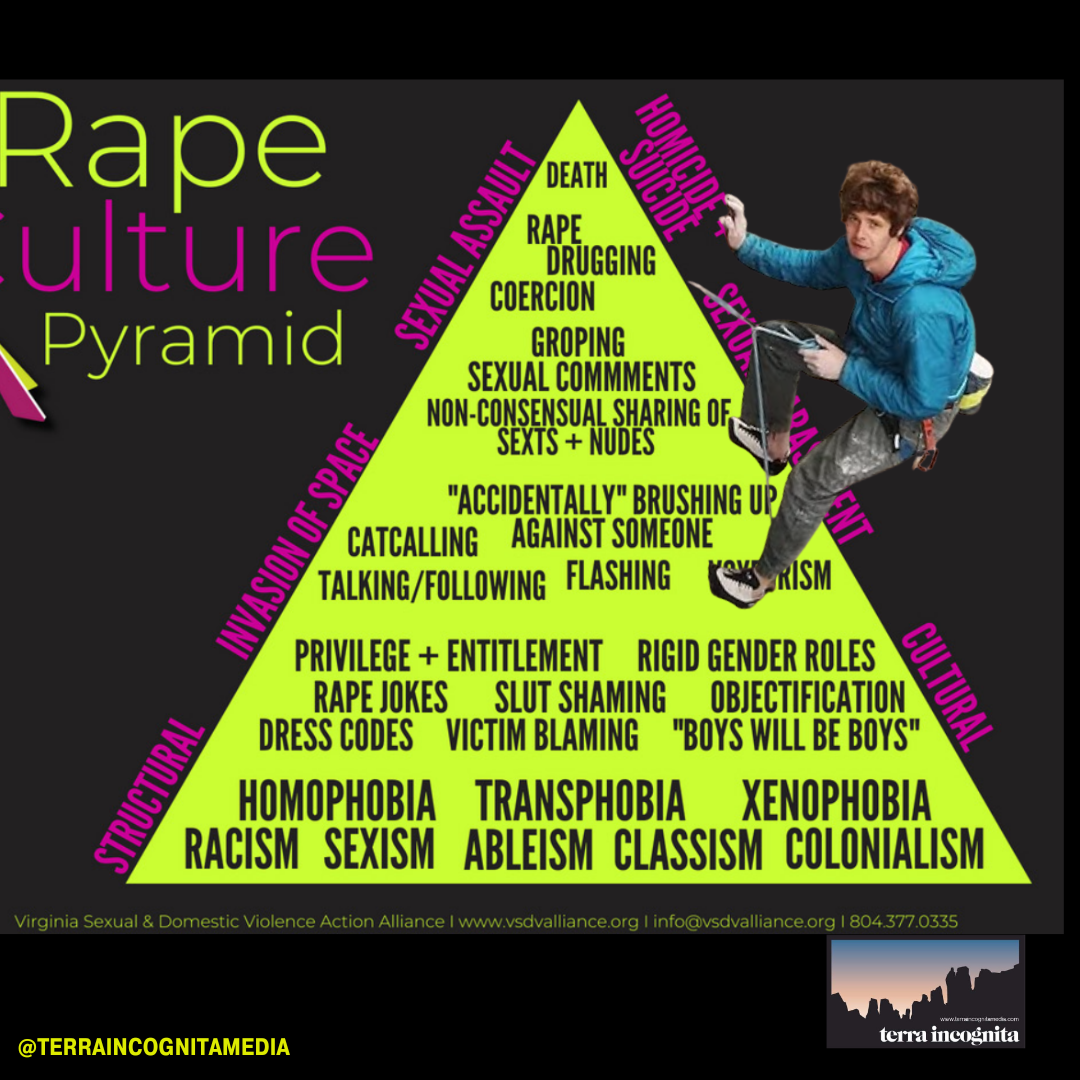
Climbing Culture is Rape Culture
Without Safe Outside, Barrett might still be free to continue his reign of terror in the climbing community today. Safe Outside, founded in 2018 in response to the #MeToo movement, is a grassroots organization spearheaded by data scientist Charlie Lieu, University of Colorado Denver criminology researcher Callie Rennison, and former Alpinist editor Katie Ives. By conducting an extensive online survey assessing sexual assault and harassment in the climbing world, Lieu was able to connect the dots by noticing common patterns across descriptions of incidents in Northern California. Because of Safe Outside’s work, survivors were able to connect, and confirm that their perpetrator was Charlie Barrett. Their incredible work and bravery ultimately led to his arrest.
So, has some semblance of justice been served? Only the survivors can answer that. From what I’ve observed of the fall out from the trial and the responses to the article, the survivors have faced untold injustice.
Rape culture persists because people like the climbers listed above treat rape as a matter of “he said, she said.” But, as Kate Manne has pointed out, it is more accurate to say, “he said, she said…she said, she said, she said.”
I had a conversation with my friend last night before publishing this piece. We discussed sexual violence, what we’ve experienced, and what others we know have experienced. What constitutes sexual violence, what it looks and sounds like, is not taught in schools. “While acts of sexual violence are often rhetorically treated as if they were extraordinary incidents, in practice they are normalized as everyday interactions,” write Lauren Chief Elk and Shaadi Devereaux in “The Failure of Bystander Intervention.” The authors continue:
“Taking advantage of drunk girls, yelling obscenities on the street, grabbing, groping, forced kissing, belittling, badgering, and verbal sexual coercion are all examples of assault not deemed ‘emergencies.’ These behaviors have been socially sanctioned and are considered acceptable, alongside many other sexually predatory behaviors. When we license men to treat consent as a matter for negotiation, predatory behavior becomes the norm…How can rapists be deterred (or even identified) when no one see any of these actions as violent to begin with?”
Just like with the institution of policing, the problem is not a few bad actors we need to remove from society. We need to examine, uproot, and replace the entire white supremacist patriarchal culture with safer, survivor-centered, consent-based institutions and mores. Like Chief Elk and Devereaux write,
“We have to work on developing deep and personal understandings of violence in our own lives. We must acknowledge how we are complicit in violence and often unknowingly violent to those who are marginalized by our social positions. This process of inner confrontation requires deep learning and engagement as a daily process. We have to grapple with the idea that violence exists within us and exorcise our collective demons while supporting victims and keeping them safe…[We need] a new structural understanding of sexual violence.”
It’s a glaring hypocrisy that a community that brands itself with words like freedom, inclusion, and subverting the mainstream still tacitly bolsters the white supremacist patriarchal status quo through himpathy, victim-blaming, gaslighting, and dismissing accusations of harm as “drama” or “rumors.” All of a sudden, men who call themselves dirtbags, pee in water bottles on the side of a cliff, and share middle school humor are vying to uphold propriety. Propriety in white supremacy means sweeping sexual violence under the rug to save face and avoid “causing a scene.”
One of the main fears people have about speaking up is that it will fracture whatever social glue holds the group together. But why shouldn’t it? Why shouldn’t violent crimes like sexual assault and gender-based violence send shockwaves through an entire community? Why shouldn’t this kind of violence galvanize each of us to do our own research, examine our behavior and complicity, and diligently eradicate rape culture from every chalky corner it seeks to tarnish?
We need to stop burying survivors’ truth. As Janey Williams says in part 4 of This Happened, “It is difficult to learn from that which you have buried.” It is beyond time to prioritize survivors’ personhood over perpetrators’. We need to believe and amplify what has happened and what is happening. It didn’t stop when Barrett was jailed. What has been revealed is how deeply rape culture festers beneath the surface at climbing gyms, competitions, events, expeditions, and crags near and far.
It is time for those who were complici to face serious consequences for the ways they aided and abetted the violence, and how they continue to prop up rape culture. It’s time for more of us to speak up against Himpathy and stand in solidarity with survivors.
TAKE ACTION
Boycott Reel Rock. Boycott all brands associated with Setter Closet. Boycott Synergy Climbing in Chattanooga, TN, owned by Lisa Rand and Wils Young. Boycott any clinics or events hosted by Wils Young, Lisa Rand, Katie Lambert, Ben Ditto, Thomasina Pidgeon, and Jackie Hueftle. Hueftle should be removed from the board of Bolt and Revolt. Send a letter of disgust to Bolt and Revolt and Lana Hansen’s employer at Mammoth Hospital.
No more platforms for himpathizers and rape apologists.